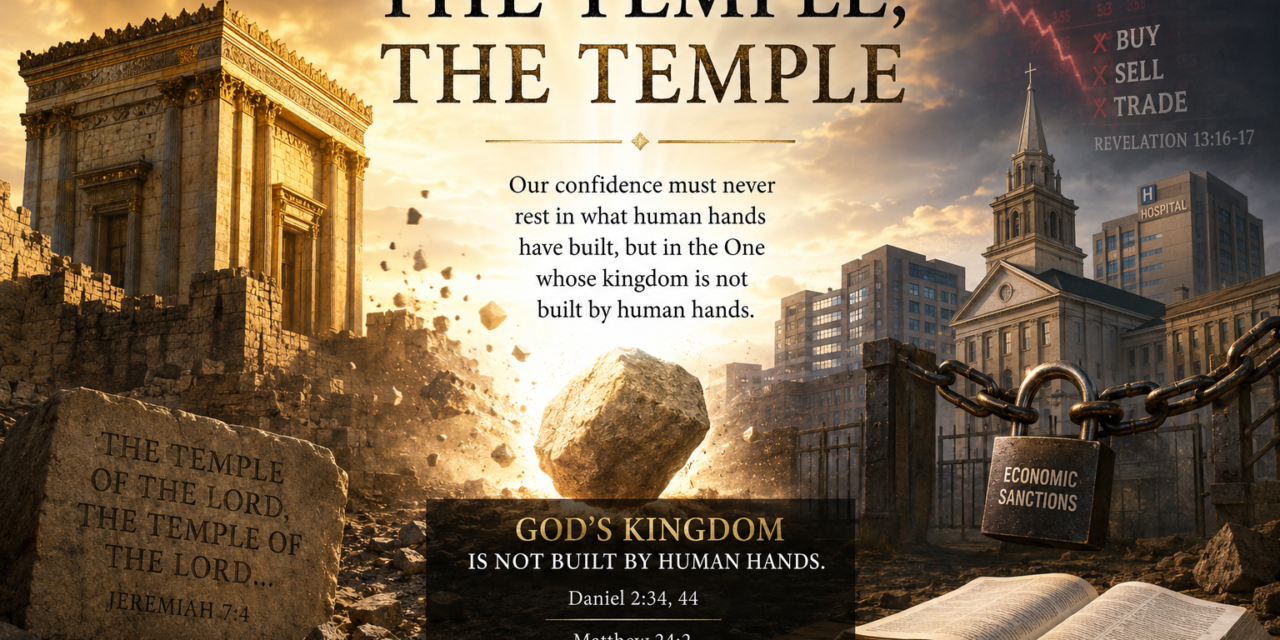
The Temple, the Temple
We live in an age of uncertainty. In just a few short years, our world has experienced events that many never imagined possible. The COVID-19 pandemic brought businesses, schools, and entire communities to a standstill. For many Christians, one of the most shocking developments was watching churches across the world close their doors.
For many believers, this raised an important question: What happens when the visible structures we have trusted are no longer available?
That question extends far beyond a pandemic.
A Crisis That Reveals Our Trust
During the pandemic, many churches suspended in-person worship. Various denominations responded differently, and many Christians were left wrestling with questions about religious liberty, conscience, and institutional authority.
Within Adventism, the handling of vaccine mandates and religious exemptions created lasting controversy. Some members felt abandoned when denominational institutions required vaccination while offering little support to employees seeking religious exemptions.
More recently, discussions surrounding these issues have resurfaced after public comments from Adventist minister Conrad Vine suggested that, in a future crisis involving the mark of the beast, the current denominational structure may not survive in its present form. His remarks generated intense debate because they challenged one of Adventism’s deeply held assumptions—that the corporate structure itself will continue intact until the end.
Whether one agrees with his conclusions or not, the discussion exposes a deeper issue.
The real dividing line is often not over doctrine, morality, or obedience to God’s commandments. Instead, it centers on one question:
Where is our confidence?
Is it ultimately in Christ, or is it in an institution?
What Happens When Buying and Selling Are Restricted?
Revelation describes a time when no one may “buy or sell” apart from compliance with the beast’s system (Revelation 13:16-17).
We often think of these sanctions affecting individuals. But modern governments also regulate corporations and religious organizations. Churches, schools, hospitals, publishing houses, and ministries all operate within legal and economic systems.
Large religious organizations possess billions of dollars in property and assets. If economic sanctions were ever enforced against faithful believers, those institutions would face impossible choices.
History provides many examples of governments confiscating church property. Following the Bolshevik Revolution in Russia, countless churches were seized, repurposed, or destroyed.
If such events occurred again, believers would have to ask an uncomfortable question:
Am I willing to lose everything for Christ?
Jesus asked the rich young ruler to surrender his possessions and follow Him. The man walked away sorrowful because his wealth had become his security (Luke 18:22-25).
The issue is not simply whether institutions could survive future persecution.
The issue is whether we have already surrendered our hearts.
God’s Kingdom Is Not Built by Human Hands
Daniel saw a stone “cut out without hands” that destroyed the kingdoms of this world (Daniel 2:34).
Later the prophecy explains that this stone represents God’s everlasting kingdom (Daniel 2:44).
The phrase “without hands” is significant.
God’s kingdom is not ultimately established by human organization, political power, or corporate structure. While organizations can serve useful purposes, they are never the foundation of God’s work.
Christ’s kingdom transcends every earthly institution.
When organizations cease to exist, God’s church remains.
The Temple of the Lord
This is not a new lesson.
In Jeremiah’s day, God’s people repeatedly declared:
“The temple of the LORD, The temple of the LORD, The temple of the LORD.”
They believed that because they possessed the temple, they were secure.
Yet they ignored injustice, idolatry, and disobedience.
God never intended His people to trust in the building itself. The temple pointed beyond itself—to God’s presence and ultimately to the Messiah.
Instead, they trusted the structure while neglecting the God who dwelt among them.
The Same Mistake in Christ’s Day
This misplaced confidence continued into the time of Jesus.
In Matthew 23, Christ pronounced repeated woes upon Israel’s religious leaders. After exposing their hypocrisy, He declared:
“Behold, your house is left unto you desolate.”
Notice His words.
He no longer called it His Father’s house.
He called it your house.
Immediately afterward, as Jesus departed from the temple, His disciples pointed out its magnificent stones and impressive buildings (Matthew 24:1; Mark 13:1).
The contrast is striking.
Jesus had just declared the temple desolate.
The disciples were still admiring the structure.
They recognized corruption among the leadership, yet they still believed the institution itself guaranteed God’s favor.
Jesus shattered that assumption.
“There shall not be left here one stone upon another.”
The temple itself would fall.
Who Was Saved?
When Jerusalem was destroyed, those who trusted the city and its temple perished.
Who escaped?
The believers who listened to Christ’s warning and fled before destruction came.
Their safety was not found in remaining loyal to a physical structure.
Their safety was found in obedience to Christ.
A Lesson for Every Generation
Every generation faces the temptation to place confidence in visible institutions.
We may trust a denomination, a church organization, a respected pastor, or a ministry more than we trust Christ Himself.
Organizations have their place. God has often used them to advance His work. But no human organization is the kingdom of God.
Institutions can become corrupt.
Buildings can be destroyed.
Assets can be confiscated.
Organizations can disappear.
Christ’s church cannot.
The church is not ultimately defined by corporate charters, property holdings, or administrative structures. It is the body of believers who remain faithful to Christ wherever they are found.
Jeremiah’s warning still speaks today:
“Trust ye not in lying words, saying, The temple of the LORD, The temple of the LORD, The temple of the LORD, are these.”
Our confidence must never rest in what human hands have built.
It must rest in the One whose kingdom was “cut out without hands” and whose reign will endure forever.