The Master’s Commentary: How Jesus Christ Unlocked the Climax of Daniel 11
When we arrive at the closing verses of Daniel 11, the prophetic narrative reaches a fever pitch. We read of alarming “tidings out of the east and out of the north,” of a wicked power planting “the tabernacles of his palace between the seas in the glorious holy mountain,” and finally, of a “time of trouble, such as never was since there was a nation” (Daniel 11:44-12:1).
For generations, sincere students of Bible prophecy have tried to decode these dramatic verses by holding a Bible in one hand and a modern newspaper in the other. Guided by traditional 19th-century frameworks, many believers continue to scan the Middle East, attempting to link these final conflicts to the Ottoman Empire, the nation of Israel, or the geopolitical movements of an Islamic caliphate.
But we do not need to rely on secular news reports or geopolitical maps to understand the climax of Daniel 11. We have something infinitely better: the ultimate, infallible commentary provided by Jesus Christ Himself.
When we place the final verses of Daniel 11 next to the 24th chapter of Matthew, we discover that Jesus directly quoted, interpreted, and unlocked these verses. When we allow the Master to serve as our expositor, the literal Middle Eastern framework dissolves, revealing a magnificent, global spiritual conflict.
The Context: The Fall of the Literal Temple
To understand how Jesus interprets Daniel, we must first recognize the context of His famous message in Matthew 24.
The chapter opens with Jesus departing from the literal, earthly temple in Jerusalem. As He walks away, His disciples approach Him to point out the magnificent stones and the physical buildings of the temple complex. They are consumed with the localized, geographic glory of the Old Covenant system. But Jesus shatters their worldview with a single sentence:
“See ye not all these things? verily I say unto you, There shall not be left here one stone upon another, that shall not be thrown down.” (Matthew 24:2)
The disciples are stunned. If the literal temple in Jerusalem is going to be destroyed, they assume it must mean the end of the world. They follow Jesus to the Mount of Olives and ask Him: “Tell us, when shall these things be? and what shall be the sign of thy coming, and of the end of the world?” (Matthew 24:3).
In response, Jesus preaches the Olivet Discourse. He weaves the local, literal destruction of Jerusalem in 70 A.D. together with the global, spiritual destruction of the world at the end of time. And right in the middle of this prophetic masterpiece, Jesus explicitly points His followers to the book of Daniel:
“When ye therefore shall see the abomination of desolation, spoken of by Daniel the prophet, stand in the holy place, (whoso readeth, let him understand:)” (Matthew 24:15)
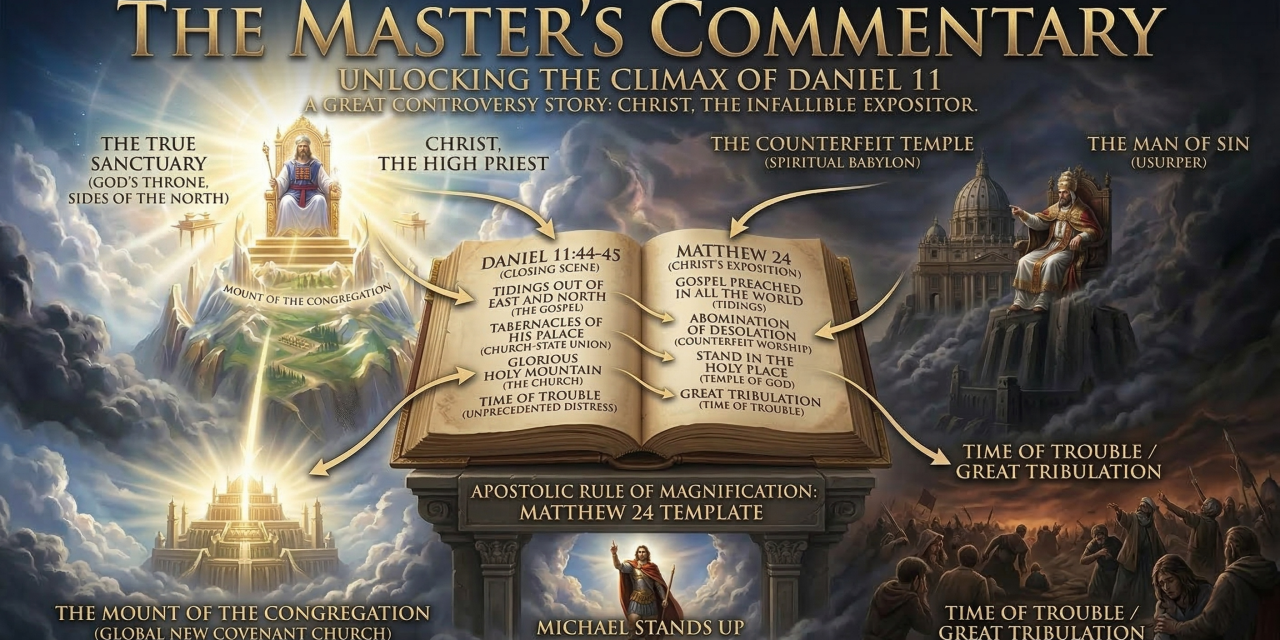
Jesus commands us to read Daniel and understand. When we place the final verses of Daniel 11 side-by-side with Matthew 24, a three-part structural parallel emerges. Jesus took the closing scenes of the King of the North and translated them into the language of the New Covenant.
Parallel 1: The Tidings vs. The Gospel
In the closing campaign of the King of the North, Daniel describes a specific event that enrages this power and triggers his final, desperate assault:
Daniel 11:44: “But tidings out of the east and out of the north shall trouble him: therefore he shall go forth with great fury to destroy, and utterly to make away many.”
If we force a literal, geopolitical interpretation onto this text, we are left grasping at historical straws. Traditional commentaries have tried to apply these “tidings” to the Crimean War, Russian troop movements, or the maneuvering of the British Empire. But what does Jesus say triggers the final events of earth’s history?
Matthew 24:14: “And this gospel of the kingdom shall be preached in all the world for a witness unto all nations; and then shall the end come.”
The “tidings” of Daniel 11 are not military reports from Russia; they are the Gospel of the Kingdom! The Hebrew word for “tidings” is shemuwah, which literally means “a report, news, or a proclamation.” It perfectly mirrors the Greek concept of evangelion—the good news, the Gospel.
But why does Daniel say this good news comes specifically from the East and the North? Because in biblical prophecy, these two directions carry massive theological weight:
-
The North: The North is the biblical seat of God’s throne, the heavenly sanctuary, and the origin of divine judgment (Psalm 48:2).
-
The East: The East is the consistent biblical direction of the Second Coming of Christ and the sealing of God’s people. Jesus Himself said, “For as the lightning cometh out of the east, and shineth even unto the west; so shall also the coming of the Son of man be” (Matthew 24:27). In Revelation 7:2, the angel possessing the seal of the living God ascends from the east.
When you combine a proclamation from the throne of God’s judgment (the North) with the imminent Second Coming of Jesus Christ (the East), what do you have? You have the Three Angels’ Messages of Revelation 14.
The “tidings out of the east and out of the north” is the final, global proclamation of the everlasting gospel. It is the announcement that the judgment has come and that Babylon is fallen. No wonder this news deeply “troubles” the King of the North (Spiritual Babylon) and provokes him to go forth with great fury to destroy the remnant who are preaching it!
Parallel 2: The Palace Tabernacles vs. The Abomination of Desolation
After the King of the North is enraged by the global gospel, Daniel describes his ultimate, blasphemous counter-attack:
Daniel 11:45: “And he shall plant the tabernacles of his palace between the seas in the glorious holy mountain; yet he shall come to his end, and none shall help him.”
What does this mean? In traditional Adventist interpretations, commentators speculated that the Ottoman Sultan (or a modern Islamic power) would eventually move his literal government headquarters (his palace) from Turkey into literal Jerusalem (the glorious holy mountain). This prediction has not come to pass and despite the American military might and power supporting the national interests of the state of Israel, many sincere believers still uphold this interpretation. This interpretation would have made sense in a 19th century geopolitical framework where the Ottoman empire still maintained control over Palestine but the history of World War 1, the capture of Jerusalem by the Britains and the fall of the Ottoman empire are historical facts that disrupt the traditional narrative.
But when we look to Jesus and the Apostles, the true, spiritual horror of this verse is revealed. Look at the parallel warning from Jesus:
Matthew 24:15: “When ye therefore shall see the abomination of desolation, spoken of by Daniel the prophet, stand in the holy place…”
The King of the North planting his palace in the “glorious holy mountain” and the “abomination of desolation” standing in the “holy place” are the same event.
Under the New Covenant, the “Glorious Holy Mountain” or the “Mount of the Congregation” is no longer a plot of real estate in the Middle East; it is the global Church of God.
But what are the “tabernacles of his palace” and the “glorious holy mountain?”
-
“The glorious holy mountain” is Mount Zion, the place of God house otherwise known as the temple. Notice Daniel’s own words equating “the holy mountain” with the city, the people and the sanctuary.
O Lord, according to all thy righteousness, I beseech thee, let thine anger and thy fury be turned away from thy city Jerusalem, thy holy mountain: because for our sins, and for the iniquities of our fathers, Jerusalem and thy people are become a reproach to all that are about us. Now therefore, O our God, hear the prayer of thy servant, and his supplications, and cause thy face to shine upon thy sanctuary that is desolate, for the Lord’s sake. Daniel 9:16-17
In the New Testament era, the city, the people and the sanctuary or temple are not literal. These pointed to a greater truth. The temple is the church or house of God comprised of faithful believers around the world.
-
A Tabernacles of his palace is the seat of civil government and royal authority; it is the domain of the State.
When the King of the North plants “the tabernacles of his palace” into the “glorious holy mountain,” it is the ultimate, blasphemous unification of Church and State. It is the merging of civil and religious power to usurp the true worship of God.
The Apostle Paul understood this perfectly. In 2 Thessalonians 2, Paul provides the definitive New Testament commentary on Daniel 11:45. Describing the ultimate anti-Christian power, Paul writes:
“Let no man deceive you by any means: for that day shall not come, except there come a falling away first, and that man of sin be revealed, the son of perdition; Who opposeth and exalteth himself above all that is called God, or that is worshipped; so that he as God sitteth in the temple of God, shewing himself that he is God.” (2 Thessalonians 2:3-4)
This is the exact same prophetic event. The Man of Sin taking his seat of authority within the “temple of God” (the Christian Church) is the New Testament fulfillment of the King of the North planting the tabernacles of his palace in the glorious holy mountain. It is Spiritual Babylon infiltrating the global church, erecting a counterfeit throne, wielding state authority, and demanding the worship that belongs only to the Creator. This was filled in the history of the Catholic church rising to power upon the ashes of the Roman empire and it will find its final fulfillment when the Protestant church rises to power in America
It is not a Turkish sultan moving a physical tent to a contested piece of land. It is the abomination of desolation attempting to rule the conscience of humanity through a global church-state union. It starts in the United States of America and will be enforced globally
Parallel 3: The Time of Trouble vs. The Great Tribulation
Finally, we reach the climax of the prophecy. As soon as the King of the North plants his church-state authority in the holy mountain, the world is plunged into the final crisis. Daniel writes:
Daniel 12:1: “And at that time shall Michael stand up… and there shall be a time of trouble, such as never was since there was a nation even to that same time: and at that time thy people shall be delivered…”
When we turn to Matthew 24, Jesus uses the exact same chronological sequence and the exact same unprecedented language to describe the result of the abomination of desolation:
Matthew 24:21: “For then shall be great tribulation, such as was not since the beginning of the world to this time, no, nor ever shall be.”
The parallels are inescapable. The “time of trouble” in Daniel 12 is the “great tribulation” of Matthew 24. It is the final outpouring of distress upon the world, triggered by the ultimate showdown between the true gospel of the Kingdom (the tidings from the East) and the counterfeit church-state union of Babylon (the tabernacles of his palace).
And beautifully, both prophecies end with the exact same promise: the deliverance of God’s people spread across the whole world.
Conclusion: Trusting the Master’s Commentary
When we step back and look at the stunning, seamless harmony between Daniel 11, Matthew 24, and 2 Thessalonians 2, the localized, 19th-century geopolitical interpretations simply fade away.
To claim that the King of the North in Daniel 11:45 is modern Turkey, or to wait anxiously for an Islamic caliphate to move its headquarters to literal Jerusalem, is to completely miss the prophetic warnings of Jesus Christ.
When we let Jesus Christ be our expositor, the magnificent reality of Daniel 11 finally comes into view. The final crisis is a global, spiritual war over the hearts and minds of every man, woman and child in every nation, kindred, tongue and people. And we have the absolute assurance that when the King of the North makes his final, desperate push against the true church, Michael will stand up, and God’s people will be delivered.