A Greek Tragedy
Today, I want to tell you a story. It’s a tragic and deeply ironic story concerning the chosen people of God. It is, in every sense of the word, a Greek tragedy.
In ancient times, the tragedy was a foundational part of Greek culture. Massively popular—particularly in Athens—these dramas were performed in massive outdoor theaters and touched on serious themes regarding religion, morality, and civic duty. But the greatest Greek tragedy wasn’t performed on a stage; it played out in the real-life history of first-century Jerusalem.
Their society, their worship, and their entire way of life centered upon the coming of a Messiah. Yet, when He finally arrived… they killed Him.
How did this happen? The answer lies in a cultural wave that swept across the ancient world: Hellenization.
The Reach of Hellenization
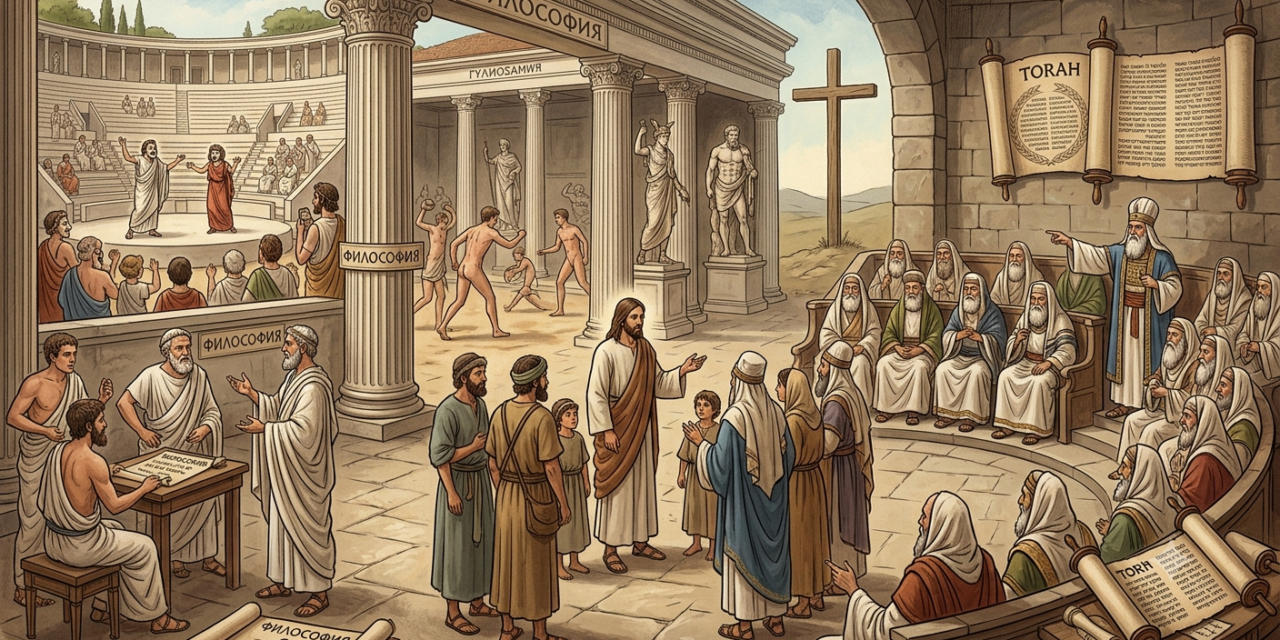
Through Alexander the Great and his rapid conquests, Greek culture—its tragedies, comedies, gymnasiums, and philosophies—was carried to the rest of the known world. This campaign to impose Greek culture, religion, and language is known as Hellenization, and it had a profound impact on the Jewish people and the early Christian Church.
To understand just how far-reaching this influence was, think of the cultural influence the United States has on the modern world.
- Years ago in Hungary, I saw a local man wearing a “Hollister” shirt. Growing up in California, I knew Hollister as just a small, unremarkable town, but as a brand, it had reached across the globe.
- Another time, in a remote village in the jungles of Fiji with no electricity, the locals were huddled around a battery-powered phone watching a modern movie.
Just as American and Western influence saturates our modern world, Greek culture saturated the ancient one. It was the language of commerce, education, and eventually, the New Testament. Even the Apostle Paul, a devout Jew, had to navigate this dual identity, quoting Greek philosophers like Aratus (“In him we live and move and have our being”) to connect with his audience in Athens.
But Hellenization didn’t just change the language; it subtly and completely revolutionized Judaism from the inside out.
Revolution #1: The Shift in Education
Before Hellenization, Jewish education was intimate and localized. It was the strict duty of a father to teach his children the Torah at home.
“And these words, which I command thee this day, shall be in thine heart: And thou shalt teach them diligently unto thy children…” — Deuteronomy 6:6-7
The Greeks, however, introduced massive, state-sponsored educational institutions like the gymnasium. These weren’t just places to lift weights; they were the centers of Greek social, intellectual, and political life. Young men would participate in naked athletics and sit at the feet of philosophers to debate Homer, rhetoric, and logic.
For elite Jewish families, the gymnasium presented a crisis of opportunity. If a young Jewish man wanted to be a recognized citizen or a successful merchant, he needed a Greek education. But getting that education meant surrounding himself with statues of Greek gods and exposing himself to ridicule.
To combat this secular influence, Jewish leaders erected their own formal institutions of learning. They created academies dedicated to the intense study and debate of Jewish law. It was the Jewish answer to the Greek philosophical schools. Soon, the “Scribes” and “Pharisees” emerged as the educated elite—the experts of the law.
They set up a system of education to counter Hellenization, but ironically patterned it after the Greeks.
When Jesus arrived, He bypassed this elite system entirely. He was home-schooled, learning at His mother’s side and in the carpenter’s shop. And what was the reaction of the educated elite?
“How knoweth this man letters, having never learned?” — John 7:15
The very experts who knew the Scriptures backward and forward were the ones the devil used to deter the mission of Christ. They were so blinded by their own academic systems that they missed the very Messiah the Scriptures pointed toward.
Revolution #2: The Shift in Governance
Originally, God led the Israelites through prophets like Moses, who appointed 70 elders to help govern the people (Numbers 11:16). But Israel had a habit of persecuting the prophets. Eventually, God stopped sending them. After Malachi died in 400 BC, a 400-year period of prophetic silence began.
What happened during those 400 silent years? Hellenization.
Without a prophet to guide them, and living under the shadow of Greco-Roman political structures, the Jewish elite created a new governing body to enforce the law. They called it the Sanhedrin.
The very word Sanhedrin is not Hebrew; it is a form of the Greek word synedrion (meaning a council or a court of law that sits in a semicircle).
Guess how many members sat on the great Sanhedrin? Seventy. (Seventy-one, including the High Priest).
These 70 men were the wealthy, ruling elite. They set themselves up as the absolute standard of Jewish faith and practice. Because of their high positions and theological expertise, they believed their interpretations were to be implicitly obeyed. They elevated their traditions above the word of God, replacing divine truth with the commandments of men.
And in the ultimate, tragic irony, it was Caiaphas—the leader of this 70-member council who condemned the Messiah to death. The earthly High priest used his authority to condemn the One upon whom his authority is based.
The Tale of Two Seventies
Jesus didn’t play their game. He wasn’t a part of their institutions of higher learning. When He chose His disciples, He selected uneducated, working-class people.
But Jesus also organized His own group. In Luke 10:1-4, Jesus appointed and sent out another group of people. How many? Seventy.
This group of 70 was the exact opposite of the 70 members of the Sanhedrin.
- They were not the wealthy ruling elite; they went out with neither purse, nor scrip, nor shoes.
- They were not academic experts; they were poor, humble, faithful laborers.
- They didn’t sit in a council passing judgment; they went out to heal the sick and proclaim the kingdom of God.
When they returned victorious, Jesus rejoiced in the Spirit and said:
“I thank thee, O Father, Lord of heaven and earth, that thou hast hid these things from the wise and prudent, and hast revealed them unto babes…” — Luke 10:21
The religious wisdom and education of the Sanhedrin blinded them to the truth. Their wisdom put the true Wisdom of God to death. But the true power of heaven was revealed unto “babes”—the unlearned and the uneducated. And those humble laborers changed the world.
The Modern Tragedy
The greatest tragedy is that we have this entire story on record, yet we are doing the exact same thing today.
In modern Christianity, and right here within Adventism, we are at risk of falling into the exact same trap. We are adopting the structures of the world to protect the truth of God, and in doing so, we are losing our way.
- We value credentials over obedience.
- We value institutions and tradition more than the raw truth of Scripture.
- We assume theological expertise equals spiritual maturity.
- We have replaced genuine discipleship with academic pursuit.
- We admire knowledge above holiness.
The ancient Israelites sought the wisdom of God by setting up educational institutions and governing bodies in response to the Greeks, but they ended up looking just like them.
The question we are left with today is simple: Which group of 70 will you be a part of?
Will you belong to the 70 “wise and prudent” who rely on institutional authority, human credentials, and tradition? Or will you be among the 70 “babes”—humble, converted, and stepping out in pure faith?
“Verily I say unto you, Except ye be converted, and become as little children, ye shall not enter into the kingdom of heaven.” — Matthew 18:3