And at the time of the end shall the king of the south push at him:
Daniel 11:40
From the 1870s until the 1920s, the “Eastern Question” was the dominant interpretation of Daniel 11:40 within the Adventist church, resting on a specific historical narrative centered around the year 1798. While the mainstream church has largely moved away from this literal, geographic application today, various independent ministries have resurrected this 19th-century view in an attempt to reclaim what they perceive as the pure, original doctrine of the pioneers. This resurrected view, codified most famously by Uriah Smith in Daniel and the Revelation, teaches that the “King of the South” in this verse was the Mamluk rulers of Egypt, who “pushed” against Napoleon Bonaparte’s French forces, triggering a retaliatory response from the “King of the North,” identified as the Ottoman Empire.
It is a dramatic narrative that seems to fit the date of 1798 perfectly. However, when we subject this interpretation to rigorous historical scrutiny, the historical record of Napoleon himself, and the very rules of biblical interpretation established by the early pioneers, the narrative completely collapses.
The historical reality of late 18th-century Egypt proves that the Mamluks were not a sovereign “King,” Egypt was not an independent state, and Uriah Smith’s attempt to force them into the text requires redefining biblical language and violating his own established hermeneutics.
Smith’s Own Rule: Geography Defines the King
Before analyzing the history, we must establish the ground rules that Uriah Smith himself laid down. How do we identify the King of the North or the South in any given era?
Smith rightly argues that these titles are geographical. In his commentary discussing the early verses of Daniel 11, he establishes that the King of the North is the power controlling the territory north of Palestine (Syria/Asia Minor), and the King of the South is the power controlling Egypt.
When he arrives at the “time of the end” in verse 40, Smith reiterates this rule of territorial succession. To identify the players in 1798, he argues, we simply look at the map:
“There can be no question that by the king of the south is here meant Egypt, and by the king of the north, Syria, which belonged to Turkey.” (Uriah Smith, Daniel and the Revelation, 1897 ed., p. 290)
Smith’s entire argument rests on the premise that whoever possesses the territory holds the title. Therefore, to justify his interpretation of verse 40, he must claim that in 1798, the Mamluks possessed the territory of Egypt as a sovereign power, distinct from the Ottoman Empire.
The fatal flaw in this theory is that in 1798, the Mamluks did not legally possess Egypt. The Ottoman Sultan did.
The Historical Reality: Egypt was Ottoman Soil
While the Mamluks—a military caste composed originally of slave-soldiers—were undoubtedly the de facto rulers on the ground in Cairo, often acting as rebellious and independent warlords, they never established themselves as a sovereign monarchy independent of the Ottoman Empire.
In the late 18th century, Egypt was legally, politically, and financially a province of the Ottoman Empire. The Mamluks were subjects of the Sultan, not rival kings. The historical evidence for this is irrefutable.
1. The Evidence of Coinage: The Ultimate Proof of Sovereignty
In the Islamic world during this period, the most definitive declaration of sovereignty was the sikka—the right to mint coins. A sovereign king mints money in his own name. A subject uses the king’s money.
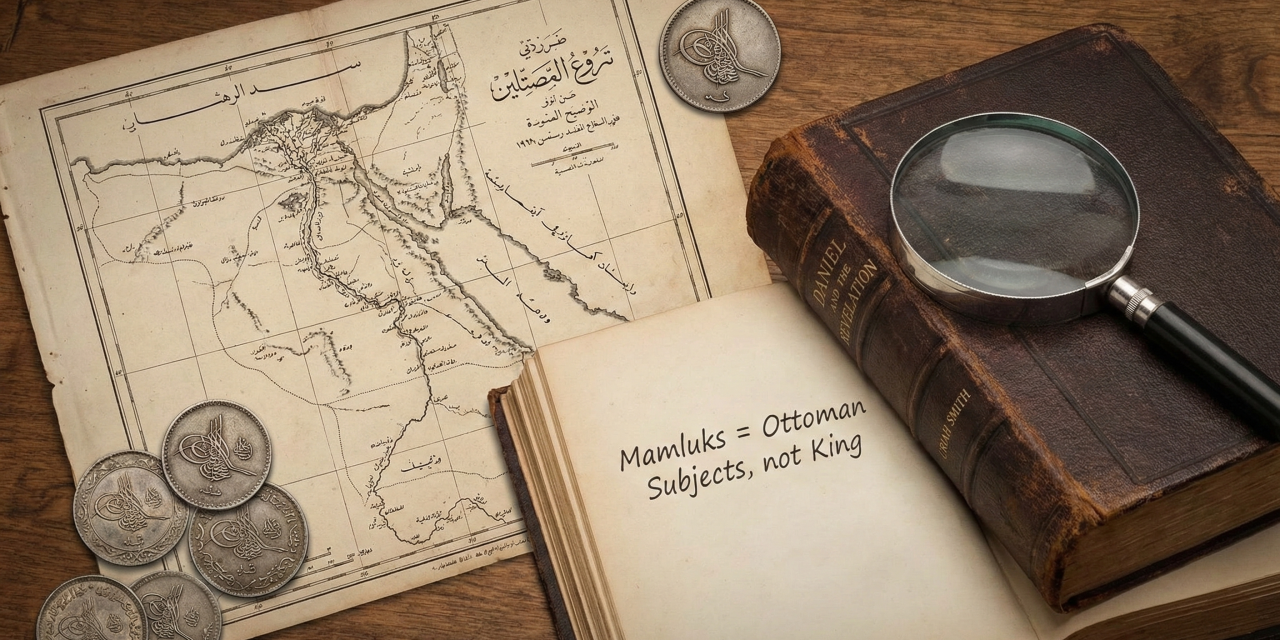
If you examine any gold Zeri Mahbub (https://en.numista.com/86110) or silver Para (https://en.numista.com/49127) minted in Cairo right up until Napoleon’s invasion in 1798, you will not find the face or name of a Mamluk Bey. Instead, these coins were struck with the Tughra—the intricate, official calligraphic seal—of the reigning Ottoman Sultan in Constantinople, such as Selim III.
By circulating the Sultan’s coinage daily, the Mamluks were providing constant, physical proof that they were subjects operating within Ottoman territory, not independent rulers of a “King of the South.”
2. The Evidence of Prayer and Law
Beyond coinage, Ottoman sovereignty was acknowledged weekly in every mosque in Egypt. During Friday prayers (the khutbah), blessings were officially invoked not for the Mamluk leaders, but for the Ottoman Sultan as the supreme Caliph and ruler of the land. Furthermore, when wealthy Mamluks established charitable trusts (called Waqf), the legal deeds were drawn up in Ottoman courts under Ottoman law, explicitly acknowledging the supreme authority of the Sultan. (See evidence at the bottom of this article)
3. Napoleon’s Own Recognition of Ottoman Sovereignty
Perhaps the most striking evidence comes from the invading forces themselves. When Napoleon Bonaparte landed at Alexandria in July 1798, he did not declare war on an independent Mamluk nation. Instead, he issued a famous Arabic proclamation to the Egyptian people, explicitly stating that he was not there to fight the Ottoman Sultan.
Napoleon declared that the French were the true friends of the Ottoman Sultan and that his invasion was solely a police action to punish the corrupt Mamluks who had defied the Sultan’s rightful authority. To legitimize his presence, Napoleon appealed to the legal sovereign of the land—the Ottoman Sultan. Even the invading French command understood the Mamluks were essentially rebellious middle-managers, not an independent monarchy. In a supreme stroke of irony, to prove the Mamluks were the “King of the South,” Uriah Smith quoted a French historian recording Napoleon explicitly recognizing that the Ottoman Sultan was the actual sovereign over Egypt……Oops
“...he [Napoleon] declared that ‘he had not come to ravage the country or to wrest it from the Grand Seignior, but merely to deliver it from the domination of the Mamelukes, and to revenge the outrages which they had committed against France.'” — Thiers’ French Revolution, Vol. IV, p. 268 (As quoted in Uriah Smith’s Daniel and the Revelation. The Grand Seignor is a reference to the Ottoman Sultan)
4. The Mamluks Were Not “A King”
Daniel 11:40 speaks of a singular “King of the South.” The Mamluks in 1798 were a fractured, quarreling military caste. At the time of Napoleon’s invasion, Egypt was being bled dry by a power struggle between two rival Mamluk warlords, Ibrahim Bey and Murad Bey, who held a tenuous joint control. Neither claimed the title of King.
Redefining Biblical Language and History: The Problem with the “Push”
Another problem with Smith’s literal interpretation is the fact that he fundamentally ignores who actually started the war and then redefines the actions described in the Bible in order to make it fit.
Daniel 11:40 states: “And at the time of the end shall the king of the south push at him…”
This phrasing requires the King of the South to be the aggressor. Yet, history records the exact opposite. The Mamluks did not initiate a conflict with France. Napoleon launched a massive, unprovoked surprise invasion of Egypt. The Mamluks were merely defending their own territory from a foreign attacker. To claim the Mamluks “pushed” at France is to historically invert the instigator and the victim.
In his commentary, Smith characterizes the Mamluk “push” as a “feeble resistence” by a technologically inferior force that was quickly wiped out by Napoleon at the Battle of the Pyramids. This begs a critical question.
Does a “feeble resistance” match the biblical definition of the word “push”? Absolutely not.
The Hebrew word used for “push” in Daniel 11:40 is נָגַח (nagach). It is a violent, aggressive verb that means “to gore” like an ox, or to overthrow. We see how Daniel uses this exact word in Daniel 8:4: “I saw the ram pushing [nagach] westward, and northward, and southward; so that no beasts might stand before him…”
In Daniel 8, nagach describes the Medo-Persian Empire aggressively conquering the known world. Yet, in Daniel 11:40, Uriah Smith takes the exact same Hebrew word and redefines it to mean a feeble, desperate defense by a localized militia that is instantly crushed.
Finally, Smith frames this narrative as a three-way war between France, the Mamluks (South), and Turkey (North). But geopolitically, the actual three-way war that decided the fate of the Middle East was between France, the Ottoman Empire, and Great Britain. It was the British Royal Navy that destroyed the French fleet at the Battle of the Nile, and it was British forces that ultimately helped the Ottomans expel the French in 1801. The Mamluks were merely a local casualty caught in the crossfire of actual global empires, not a prophetic “King” instigating the conflict.
Violating William Miller’s Rules of Interpretation
The early Adventist movement rested on a solid foundation of hermeneutics, most notably William Miller’s 14 Rules of Interpretation. Uriah Smith’s literal Turkey/Mamluk view systematically violates several of the most critical rules on this list.
1. Violating Rule IV: The Rule of Parallelism Miller taught that the major prophetic outlines of Daniel (chapters 2, 7, 8, and 11) run parallel to one another, culminating in the same final power.
-
In Daniel 2, the final power before the stone strikes is Rome.
-
In Daniel 7, the final power before the judgment is the Roman Little Horn.
-
In Daniel 8, the final power is Rome. Consistency demands that the final power in Daniel 11 must also be the Roman power in its final phase (the Papacy). Uriah Smith abandons this parallel structure, swapping out a global, systemic power (Rome) for localized Middle Eastern politics (Turkey and the Mamluks).
2. Violating Rule XIII: Fitting in “Every Particular” Miller’s 13th rule states: “To know whether we have the true historical event for the fulfilment of a prophecy. If you find every word of the prophecy… is literally fulfilled, then you may know that your history is the true event.” Smith’s interpretation fails this test entirely. The Mamluks did not “push” (gore/conquer); they were slaughtered. Furthermore, looking ahead to verse 43, Smith claims Turkey had “power over the treasures of Egypt.” Yet history shows that shortly after the French left, the Albanian-Ottoman commander Muhammad Ali Pasha seized control of Egypt, hoarded its wealth, built his own massive army, and nearly destroyed the Ottoman Empire. The history does not fit the prophecy in every particular.
3. Violating Rule XII: Let the Bible Define Its Figures Miller’s 12th rule states that to understand a figure, we must “trace it in your Bible, and where you find it explained, put it on your figure.” Smith insists that the King of the South must refer to the literal dirt of Egypt. However, the New Testament explicitly redefines “Egypt” spiritually. Revelation 11:8 describes the great city “which spiritually is called Sodom and Egypt.” By ignoring the Bible’s own spiritual definition of Egypt in the New Covenant era, Smith forces a literal geographical interpretation onto a spiritual prophecy.
I’ve heard many people appeal to William Miller’s rules as validation for a literal interpretation of Daniel 11:40-45. The irony of it all is that William Miller himself interpreted vs. 36-45 and the King of the North as being not literal but symbolic. He along with many other early Adventists believed the King of the North was the little horn or the Papacy. It’s akin to using Ellen White to support feast keeping.
Conclusion
The historical facts are inescapable. In 1798, the Mamluks minted the Sultan’s coins, prayed for the Sultan’s reign, submitted to the Sultan’s courts, and were recognized by Napoleon himself as subjects of the Ottoman Empire operating on Ottoman soil.
Therefore, according to Uriah Smith’s own geographical rule, the “King of the South” in 1798 was the Ottoman Empire.
Daniel 11:40 describes a three-way conflict where the King of the South pushes at the willful king, and the King of the North comes against him. If the Mamluks and Turkey were legally the exact same empire, then the King of the South and the King of the North are the exact same entity. This renders Smith’s interpretation of a three-way war involving France prophetically and logically absurd. It is time to align our understanding of this prophecy with the irrefutable testimony of history, the consistent testimony of Scripture, and the foundational rules of interpretation.
Primary Source Evidence: The Waqfiyah of Abu al-Dhahab
Source: Excerpted from The Waqfiyah of Muhammad Bey Abu al-Dhahab, translated and edited by historian Daniel Crecelius.
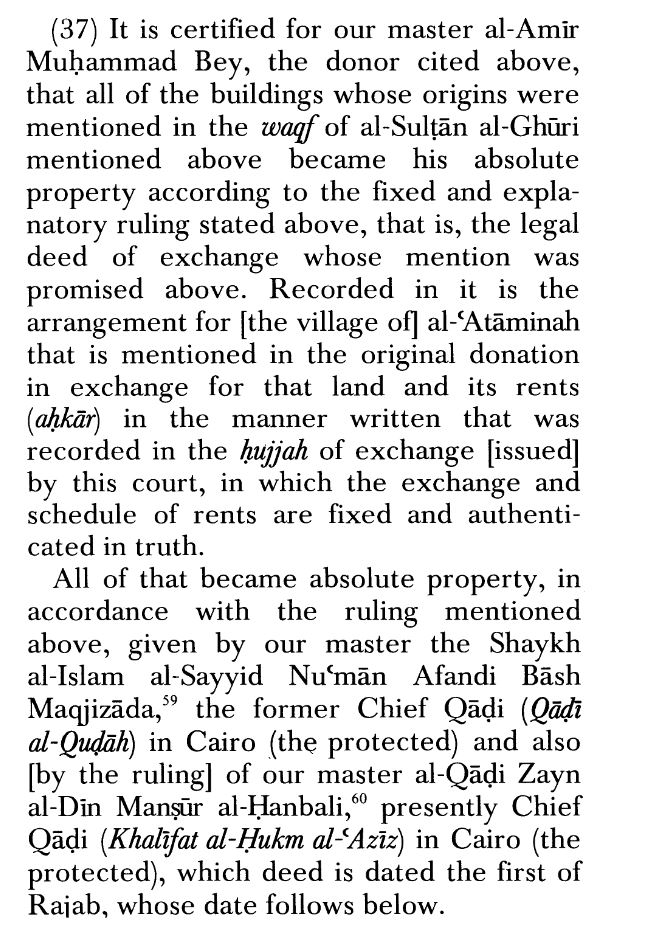
To fully grasp why the Mamluks cannot be prophetically identified as a sovereign “King of the South,” we must look at their own legal documents. Below is an excerpt from the waqf (charitable endowment deed) of Muhammad Bey Abu al-Dhahab. Established in 1774, this document was created by one of the most powerful and wealthy Mamluk warlords in Egypt just decades before Napoleon’s invasion.
Despite his immense military power, the legal language within his own property deed irrefutably proves his submission to the Ottoman Empire.
Here is the text of paragraph 37 from the deed:
(37) It is certified for our master al-Amir Muhammad Bey, the donor cited above… that all of that became absolute property, in accordance with the ruling mentioned above, given by our master the Shaykh al-Islam al-Sayyid Nu’man Afandi Bash Maqjizada, the former Chief Qadi (Qadi al-Qudah) in Cairo (the protected) and also [by the ruling] of our master al-Qadi Zayn al-Din Mansur al-Hanbali, presently Chief Qadi (Khalifat al-Hukm al-‘Aziz) in Cairo (the protected)…
When we break down the legal terminology in this single paragraph, the “King of the South” narrative entirely collapses:
-
Titles of Subordination, Not Sovereignty: The document legally identifies the donor as “our master al-Amir Muhammad Bey.” “Amir” is a military title meaning commander, and “Bey” is a Turkish provincial designation. He is never referred to as Sultan (Emperor) or Malik (King). Legally, he is classified as a high-ranking military officer within a larger empire, not an independent monarch.
-
Submission to a Higher Court: If Abu al-Dhahab were an independent, sovereign king, his decree alone would be the law of the land. Instead, the text shows he had to go to a separate legal body to have his property rights certified and authenticated. He is submitting his wealth to a legal system greater than himself.
-
The Supreme Authority of the Ottoman Qadi: The text explicitly states that Abu al-Dhahab’s property rights are entirely dependent on the rulings of the “Chief Qadi [Judge] in Cairo.” Historically, the Chief Qadi of Cairo was never an Egyptian or a Mamluk; he was a high-ranking Ottoman state official dispatched directly from Istanbul by the Ottoman Sultan. This powerful Mamluk warlord is literally bowing to the legal ruling of the Ottoman Sultan’s appointed representative in order to protect his own property.
-
Ottoman Cultural and Imperial Markers: The document utilizes titles such as “Afandi” (Effendi), a classic Ottoman Turkish title of respect for government officials and scholars. The presence of this title further cements that the legal apparatus ratifying this Mamluk’s wealth was culturally, legally, and officially Ottoman.
The Conclusion of the Evidence This primary source document provides hard, historical proof that the Mamluks did not have sovereign authority over the territory of Egypt. Even the wealthiest, most dominant Mamluk warlords had to go to the Ottoman courthouse, stand before an Ottoman-appointed judge, and receive an Ottoman legal ruling just to manage their own local affairs. Because Egypt was legally Ottoman territory, governed by Ottoman courts, the “King of the South” in 1798 could only have been the Ottoman Empire itself.