If you read the eleventh chapter of the book of Daniel carefully, you will stumble upon a fascinating structural mystery. In the early verses, the prophetic narrative is entirely dominated by two specific geopolitical titles: the “King of the North” and the “King of the South.” But suddenly, starting in verse 26 and continuing all the way through verse 39, these compass-point titles completely vanish from the biblical text.
For fourteen consecutive verses, the prophet describes a massive, devastating conflict. He speaks of a power that pollutes the sanctuary, takes away the daily ministration, and persecutes the people of God with sword and flame. Yet, the geographical titles “King of the North” and “King of the South” are nowhere to be found.
Then, just as suddenly, in verse 40—at the “time of the end”—the titles dramatically reappear: “And at the time of the end shall the king of the south push at him: and the king of the north shall come against him…”
Why do these specific titles disappear for such a long stretch of the prophecy? And what happens to the people of God during that gap?
The answer to this structural anomaly is the key that unlocks the entire chapter. Yet, for over a century, many sincere students of Bible prophecy have missed this transition because they generally overlook the covenantal architecture built into the prophetic sequence of Daniel 8-12. In our desire to be faithful to the text and to the prophetic history of our pioneers, we have sometimes overlooked the magnificent theological shift established by Jesus Christ and the Apostles.
When we set aside 19th-century geopolitical expectations and allow the Bible to dictate its own structure, an airtight, biblically sound case emerges. Daniel 11 is not a standalone vision about modern Middle Eastern border disputes. It is the final, detailed explanation of a single prophetic sequence spanning Daniel 8 through 12. And woven right into the middle of this sequence is the cross of Jesus Christ—an event that fundamentally magnified how biblical prophecy operates.
The Law of Parallel Starting Points
To prove that Daniel 8, 9, and 11 are the exact same prophetic timeline overlaid upon each other, we simply have to look at where they begin. God does not leave us guessing; He anchors every phase of this vision to the exact same historical starting point.
-
Daniel 8 (The Vision): The vision of the “evenings and mornings” begins with a Ram pushing westward. The angel explicitly identifies this Ram to Daniel: “The ram which thou sawest having two horns are the kings of Media and Persia” (Daniel 8:20).
-
Daniel 9 (The key): Gabriel returns to explain the timeline of the vision. The 70-week countdown does not start with Babylon; it officially begins with the “going forth of the commandment to restore and to build Jerusalem” (Daniel 9:25)—a decree issued by the Persian King Artaxerxes in 457 B.C.
-
Daniel 11 (The Final Explanation): When Gabriel comes to give the final historical overlay, he begins with the exact same empire: “Behold, there shall stand up yet three kings in Persia…” (Daniel 11:2).
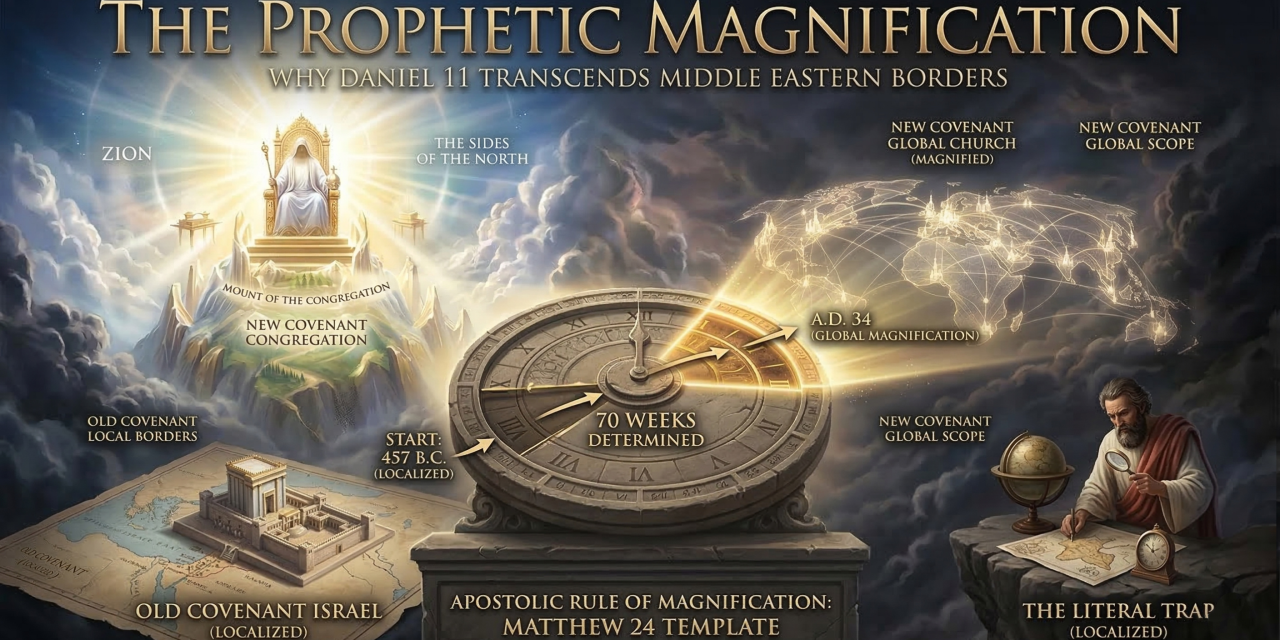
Because Daniel 8, 9, and 11 all begin with the Medo-Persian empire and end with the final destruction of the enemy at the end of time, they must be overlaid on top of one another. This means that the events of Daniel 11 must be strictly governed by the chronology and the covenantal relationship to the literal city and people of God established by the time-prophecy of Daniel 9. It is not only the key to understand the starting point of the 2300 days but also they key to understanding a shift from the literal and local to the spiritual and global.
The 70 Weeks and the Localized Covenant
When the angel Gabriel came to give Daniel the timeline for the vision, he laid out a very specific time period where the focus of God’s people should be on literal nation of Israel and the earthly Jerusalem. He declared:
“Seventy weeks are determined upon thy people and upon thy holy city…” (Daniel 9:24).
For those 490 years, God’s covenant was intensely localized. It was tied to a literal bloodline (the Jews), a literal geography (Palestine), a literal city (Jerusalem), and a literal building (the temple).
Because the covenant was geographically localized, the enemies attacking God’s people were also literal, geographical nations to the north and south of Palestine. While God’s covenant focused on the literal land of Palestine in the Old Covenant so too the titles “King of the North” and “King of the South” were to be understood literally and geographically in relation to His people and the city of Jerusalem.
If we strictly overlay the 70 weeks of Daniel 9 onto the historical narrative of Daniel 11, the 490 years perfectly span verses 1 through 22.
This block of history covers the Persian kings, the mighty exploits of Alexander the Great, the division of the Grecian empire into the four winds, the literal geographic wars between the kings of the North and South, and the rise of Pagan Rome as the new oppressor.
How do we know this chronological alignment is correct? Because Daniel 11:22 culminates with the exact same event that anchors the 70 weeks:
“…yea, also the prince of the covenant [shall be broken].” This is the crucifixion of Jesus Christ in 31 A.D. by the Roman Empire. This perfectly fulfills the promise of Daniel 9:27 that the Messiah would confirm the “covenant for one week” and would be “cut off” in the midst of the 70th week. The cross is the hinge upon which the entire prophecy
When it comes to the 70 weeks prophecy, we apply the day for a year principle yet when we look to the context of Daniel 9 we do not see any symbols being used in the Chapter. A proper prophetic hermeneutic would dictate that we should apply this time period as being literal and not symbolic, however, because this chapter is a continuation or explanation of the original vision in Chapter 8 then the use of prophetic symbols applied to time is warranted. The same argument can also apply to Daniel 11. Because it is an explanation of Daniel 8, symbolic language can also be used but when we should interpret literal and when we should interpret it in a symbolic sense is determined by the covenental framework of the 70 weeks.
The Two Mountains: Transitioning from Earthly to Heavenly
When the 70 weeks ended in 34 A.D. (marked by the stoning of Stephen and the gospel going to the Gentiles), the localized Old Covenant dispensation officially came to a close. And when the Old Covenant ended, the geographic constraints of biblical prophecy were fundamentally rewired.
The Apostle Paul uses the allegory of two covenants to redefine the “Mountain of the Lord,” showing that the promises of God have been magnified from a localized patch of dirt in the Middle East to a global, spiritual reality. In Galatians 4, Paul explicitly strips literal, earthly Jerusalem of its prophetic supremacy. He writes that the earthly Jerusalem “is in bondage with her children.” Instead, the true mountain of God’s people is now a spiritual reality:
“But Jerusalem which is above is free, which is the mother of us all.” (Galatians 4:25-26)
Paul builds on this exact theology in the book of Hebrews, contrasting the physical Mount Sinai with the spiritual Mount Zion of the New Covenant. He tells the early Christian church:
“For ye are not come unto the mount that might be touched, and that burned with fire… But ye are come unto mount Sion, and unto the city of the living God, the heavenly Jerusalem, and to an innumerable company of angels, To the general assembly and church of the firstborn…” (Hebrews 12:18, 22-23)
Under the Old Covenant, the mountain of God could be physically touched. It was a GPS coordinate in the Middle East. Under the New Covenant, the “Mount Zion” that believers are gathered to is the heavenly assembly and the global Christian church.
When the true “Mountain of the Lord” transitioned to the Heavenly Jerusalem, Satan’s strategy had to shift. He could no longer attack God’s mountain by sending literal armies to the Middle East, because God’s mountain was no longer there! To attack the New Covenant “Mount Zion,” Satan had to create a New Covenant counterfeit.
The Evangelical Trap: Vacillating Between Covenants
By insisting that the end-time King of the North in Daniel 11:40 is a literal Middle Eastern power fighting over literal Jerusalem, literalist interpreters inadvertently fall into the exact same theological trap as modern Evangelical Futurism (Dispensationalism).
Modern Evangelical theology vacillates erratically between the two covenants. On one hand, they correctly believe the Christian church is currently operating under the global New Covenant of grace. But on the other hand, they believe the localized Old Covenant is still somehow valid and actively operating for literal, national Israel—and that prophecy will culminate in a literal military battle involving modern tanks in the Middle East.
This dual-covenant theology directly contradicts Scripture. The writer of Hebrews makes it abundantly clear what happened to the localized system:
“In that he saith, A new covenant, he hath made the first old. Now that which decayeth and waxeth old is ready to vanish away.” (Hebrews 8:13)
The Old Covenant was decaying and ready to vanish. In 70 A.D., when the Roman armies destroyed the literal temple and literal Jerusalem, that localized covenant system permanently vanished. You cannot drag a vanished covenant back to life to fulfill end-time prophecy. This is similar to modern dispensational interpretation of separating the final week of the 70 week prophecy and placing it in the future. When we force Daniel 11:40 into a literal Middle Eastern conflict, we are functionally agreeing with the Evangelical deception, placing the prophetic focus back onto geographical borders that God has already moved beyond.
The Matthew 24 Template: Local to Global
To understand how prophecy handles this transition from the vanished Old Covenant to the New Covenant, we must look to Jesus Himself in Matthew 24.
When the disciples asked Jesus about the destruction of the literal temple and the end of the world, Jesus did not give them two separate sermons. He wove the two events into a single, dualistic prophecy. The literal, local destruction of Jerusalem in 70 A.D. served as the template for the magnified, global destruction of the world at the end of time.
Notice carefully what Jesus did: He did not discard the literal history, nor did He “spiritualize it away” into meaninglessness. He magnified it. The local crisis of the Jewish nation became the blueprint for the worldwide crisis of the global church.
The Apostolic Rule of Magnification
Following the exact template of Jesus, the Apostles systematically took the literal geography of the Old Testament and magnified it to fit the global Christian Church. They did not erase the promises of God; they expanded them to encompass the whole world.
-
Literal Israel become the True Israelites by Faith: Being a “Jew” is no longer about physical bloodlines. “And if ye be Christ’s, then are ye Abraham’s seed, and heirs according to the promise” (Galatians 3:29).
-
The Literal Temple points to a Heavenly Temple: With the literal building gone, the Apostles taught that the global church is now the temple. “Ye also, as lively stones, are built up a spiritual house…” (1 Peter 2:5).
-
Literal Babylon becomes Global Spiritual Babylon: The literal empire of Babylon was destroyed centuries before Christ. Yet, Revelation 17 identifies the end-time apostate church as “Mystery, Babylon the Great.”
-
Literal Egypt becomes Global Spiritual Egypt: John describes the two witnesses being killed in “the great city, which spiritually is called Sodom and Egypt, where also our Lord was crucified” (Revelation 11:8).
If Jesus and the Apostles magnified Israel, the Temple, Babylon, and Egypt from local Middle Eastern dirt to worldwide, spiritual realities, we are biblically required to apply this exact same rule to the King of the North and the King of the South in Daniel 11.
The Magnified War
Since Daniel 9 itself is part of the prophecy connected to Daniel 11, it is the key that explains the structural mystery and the shift from literal to spiritual in Daniel 11.
Immediately after the “Prince of the covenant” is broken in verse 22 (the cross), the 70 weeks expire. Consequently, the localized geography of the Old Covenant ceases to hold prophetic significance.
Verse 23 and onward in Daniel 11 perfectly corresponds to the birth and growth of the Christian church. During this period, the “Glorious Land” is not referring to literal Palestine; it is the global church. Because God’s people are no longer geographically localized, their enemies can no longer be defined by literal compass points on a Mediterranean map.
Instead of literal border wars, verses 23 through 39 describe a magnified, global war over truth.
-
Verse 23 details the “league”—the deceitful church-state union under the Roman Empire that eventually gave birth to the Papacy.
-
Verse 31 describes this counterfeit system polluting the heavenly sanctuary and taking away the daily ministration of Christ, replacing it with an earthly priesthood.
-
Verses 32-35 describe the 1260 years of Papal persecution where the true, global church fell by the sword and flame during the Dark Ages.
-
Verses 36-39 describe the King who “exalts himself above every god,” speaking marvelous things against the God of gods—a perfect prophetic parallel to the Little Horn of Daniel 7 and the Man of Sin in 2 Thessalonians 2.
For these fifteen verses, the war is entirely spiritual. The battlefield is the human heart, the prize is the truth of the gospel, and the enemy is the Papal system.
The Return of the Kings (Verse 40)
When we finally arrive at the “time of the end” in verse 40 (beginning in 1798 A.D. at the conclusion of the 1260 years), the titles suddenly reappear:
“And at the time of the end shall the king of the south push at him: and the king of the north shall come against him…”
We cannot drag an Old Covenant geographic limitation into a post-70-Weeks, New Covenant era. If the people of God are now a global church, then the powers attacking them at the end of time must also be global and systemic. The kings have returned, but they have been magnified.
-
The King of the South (Egypt) has been magnified from literal Pharaohs to the global ideology of “Egypt” (Revelation 11:8)—the atheistic, secular, and humanistic worldview that famously “pushed” against the Papacy during the French Revolution, inflicting the deadly wound in exactly 1798.
-
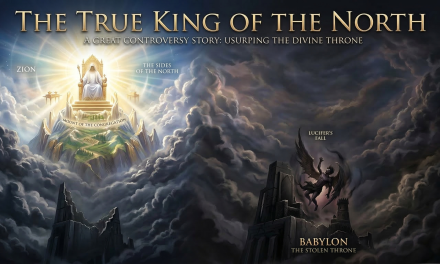
The King of the North (Babylon) has been magnified from literal Syrian armies to “Mystery Babylon”—the global Papal system that usurps the throne of God. According to the prophecy, this system recovers from its wound and comes back against secularism like a whirlwind, sweeping away the atheistic push and dominating the world stage once more.
Conclusion: Advancing in Prophetic Light
To claim that the King of the North in Daniel 11:40 is modern Turkey or localized Islam is to completely bypass the cross of Jesus Christ. It ignores the 70-Week prophecy of Daniel 9, disregards the vanishing of the Old Covenant, and attempts to force the magnified, worldwide New Covenant church back under the geographical constraints of a system that ended in 70 A.D.
We honor our pioneers not by blindly repeating their 19th-century geopolitical commentaries, but by carrying their torch of intense biblical inquiry forward. By acknowledging the fulfillment of the 70 weeks, understanding the transition from the earthly Mount Zion to the heavenly, and honoring the Matthew 24 template of magnification, the progression of Daniel 11 becomes undeniably clear.
The final crisis is not a literal military battle over dirt in Palestine. It is a magnified, worldwide war over the minds, souls, and worship of humanity. The King of the North is the great spiritual counterfeit, and his final campaign is aimed directly at the global remnant of God.