
And at the time of the end shall the king of the south push at him:
Daniel 11:40
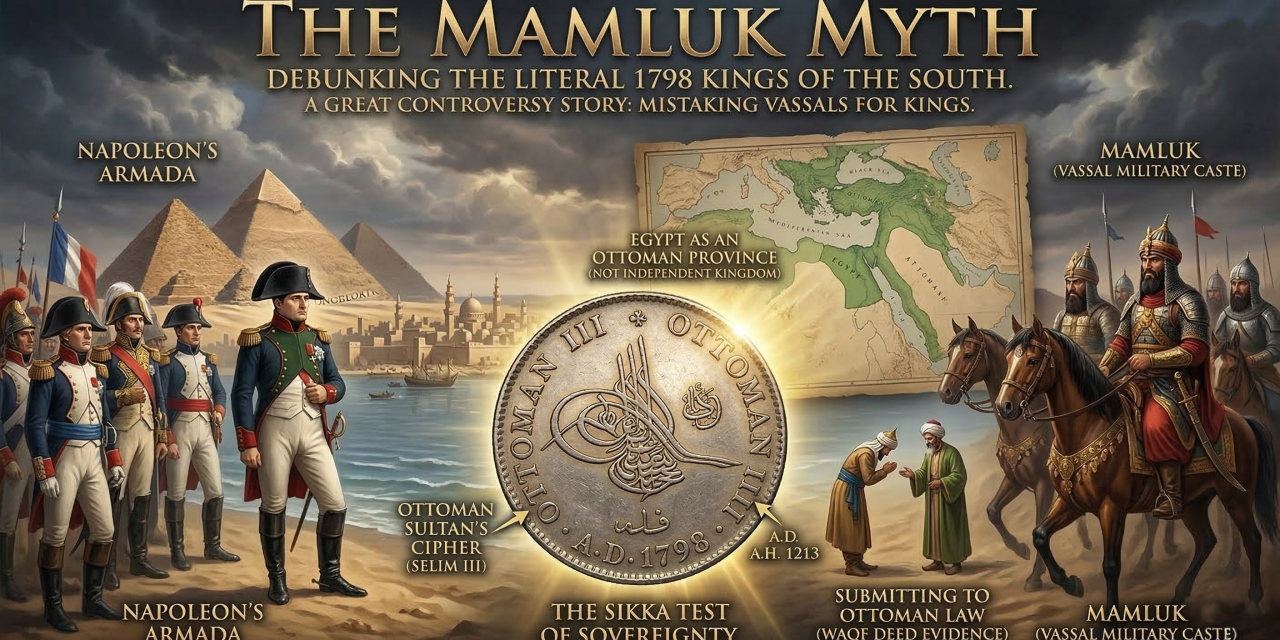
In the summer of 1798, Napoleon Bonaparte sailed a massive French armada across the Mediterranean and marched his armies into the blistering deserts of Egypt. It was a military campaign that set off a chain of geopolitical shockwaves, capturing the attention of the world and permanently altering the balance of power in Europe and the Middle East. For over a century, sincere students of Bible prophecy have looked back to this exact invasion as the definitive key to unlocking the final conflicts of Daniel 11.
Popularized in the 1800’s by the monumental commentary by Uriah Smith, Daniel and the Revelation, the literal view holds that France (under the leadership of Napoleon) is the “him” of Daniel 11:40. According to this specific prophetic timeline, when France invaded Egypt, the “King of the South” (identified in this view as the local Mamluks ruling Egypt) pushed at him. In immediate retaliation, the “King of the North” (the Ottoman Empire, or Turkey) came against the French like a whirlwind with chariots, horsemen, and ships.
Because this interpretation has been in print for generations, many faithful believers hold tightly to this literal Middle Eastern framework out of a commendable desire to honor our church history. They deeply respect the early Advent movement and wish to defend the traditional eschatology that guided its pioneers.
However, honoring our history does not mean we must freeze our understanding of it. When we objectively examine the historical and biblical foundation of the 1798 “Turkey and Egypt” view, we discover a profound problem. The 19th-century European historical sources that early expositors relied upon were fundamentally flawed. The benefit of time and scholarly research have allowed us to test the literal interpretation not with secondary documentation but by primary source evidence. When tested against these primary source documents from the Middle East, the strict rules of Islamic sovereignty, and the original Hebrew text of Daniel, the literal geographical interpretation completely collapses.
The Foundation of the 1798 Interpretation
The traditional interpretation of Daniel 11:40 centers entirely on the geopolitics of the year 1798. For this interpretation to be biblically accurate, the Mamluks of Egypt had to be a sovereign, independent nation.
If we are to interpret the prophecy from a strict literalistic point of view then the titles like “King of the South” or “King of the North” demand absolute sovereign authority. You cannot be a biblical “King” of a prophetic geographic domain if you are merely a vassal, a rogue governor, or a mercenary. To fulfill the prophecy, Egypt had to be a standalone kingdom capable of engaging in sovereign, international warfare against another independent kingdom (Turkey or France).
So, the historical question that determines the validity of the literal interpretation is simple: Was Egypt an independent kingdom ruled by sovereign Mamluk kings during Napoleon’s invasion in 1798?
The historical reality is a resounding no.
In 1798, Egypt was not a sovereign nation; it was a province of the Ottoman Empire, and it had been ever since the Ottomans conquered it in 1517. The Mamluks were not kings. Historically, the word mamluk literally translates to “property” or “owned slave.” They were a powerful military caste of slave-soldiers, primarily of Kipchak Turk and Circassian origin, who were purchased, converted to Islam, and trained as elite cavalry.
While the Mamluks frequently caused localized trouble, assassinated political rivals, and amassed great personal wealth, they were functioning as vassals under the supreme, legal authority of the Ottoman Sultan in Istanbul. They paid an annual tribute (miri) to the Ottoman capital. They were never legally recognized as an independent kingdom by the international community, by European powers, or by Islamic law.
To claim that the Mamluks were the sovereign “King of the South” in 1798 is equivalent to claiming that a powerful, corrupt governor of a Roman province was the Emperor, not of Rome but of his own kingdom.
The Ultimate Test of Sovereignty: Coinage and the Khutbah
In the Islamic world during the 18th century, sovereignty was not determined merely by who had the most swords, who owned the most land, or who collected the local taxes. Under strict Islamic law and tradition, there were two absolute, non-negotiable proofs of independent sovereignty: the Khutbah and the Sikka.
The Khutbah is the primary Friday sermon delivered in the mosques. In an independent Islamic kingdom, the sermon is always delivered in the name of the sovereign ruler, officially asking God to bless his reign. The Sikka refers to the exclusive right to mint coinage. A true, independent king strikes coins bearing his own name and his own royal cipher (tughra).
Did the Mamluk warlords possess these rights in 1798? Absolutely not.
Throughout the entire period leading up to and including the French invasion of 1798, the Friday prayers in every mosque in Cairo were said in the name of the Ottoman Sultan in Istanbul. Furthermore, the Mamluks did not mint their own sovereign currency.
Every legal coin struck in the mint of Cairo during this era bore the name and cipher of the ruling Ottoman Sultan (at the time of Napoleon’s invasion, this was Sultan Selim III). If a Mamluk warlord had attempted to strike a coin with his own face or name on it, or if he had demanded the Friday prayers be said in his honor, it would have been an act of open, undeniable treason against the Ottoman Empire. The Mamluks never took this step because they knew they were not the sovereign rulers of the land.
Because they did not possess the Sikka or the Khutbah, they cannot, by any historical or legal standard, be classified as the independent “King of the South.”
The Primary Source Evidence: The Waqf of Abu al-Dhahab
We no longer have to guess about the political status of Egypt in the 18th century, nor do we have to rely on outdated, biased 19th-century European histories that viewed the Middle East through an imperial lens. Today, modern historians have translated the actual legal property deeds (waqfiyyas) of the Mamluks themselves directly from the Ottoman archives.
To fully grasp why the Mamluks cannot be prophetically identified as the sovereign “King of the South,” we can examine the legal property deed of Muhammad Bey Abu al-Dhahab. Established in 1774, this waqf was created by one of the most powerful and wealthy Mamluk warlords in Egypt just two decades before Napoleon’s invasion.
Despite his immense military power, the legal language within his own property deed irrefutably proves his complete submission to the Ottoman Empire. Here is the text of paragraph 37 from the deed, meticulously translated by Middle Eastern historian Daniel Crecelius:
(37) It is certified for our master al-Amir Muhammad Bey, the donor cited above… that all of that became absolute property, in accordance with the ruling mentioned above, given by our master the Shaykh al-Islam al-Sayyid Nu’man Afandi Bash Maqjizada, the former Chief Qadi (Qadi al-Qudah) in Cairo (the protected) and also [by the ruling] of our master al-Qadi Zayn al-Din Mansur al-Hanbali, presently Chief Qadi (Khalifat al-Hukm al-‘Aziz) in Cairo (the protected)…
When we break down this legal terminology, the traditional 1798 “King of the South” narrative entirely unravels:
-
Titles of Subordination, Not Sovereignty: The legal document identifies the donor as “our master al-Amir Muhammad Bey.” “Amir” is a military title meaning commander, and “Bey” is a Turkish provincial designation given to administrators. He is never referred to as Sultan (Emperor) or Malik (King). Legally, he is classified as a high-ranking military officer operating within the Ottoman Empire, not an independent monarch.
-
Submission to a Higher Court: If Abu al-Dhahab were an independent, sovereign king, his decree alone would be the law of the land. The word of a king is final. Instead, the text shows he had to go to a separate, higher legal body to have his property rights certified and protected.
-
The Supreme Authority of the Ottoman Judge: The text explicitly states that his property rights are entirely dependent on the rulings of the “Chief Qadi [Judge] in Cairo.” Historically, the Chief Qadi of Cairo was never an Egyptian or a Mamluk. The Chief Qadi was a high-ranking Ottoman state official dispatched directly from Istanbul by the Sultan. This powerful Mamluk warlord is literally bowing to the legal ruling of the Ottoman Sultan’s appointed representative in order to protect his own property.
This primary source document provides hard, irrefutable historical proof that Egypt was legally Ottoman territory, governed by Ottoman courts, and subject to Ottoman law.
Therefore, if we insist on a literal interpretation of 1798, the “King of the South” (Egypt) and the “King of the North” (Turkey) would actually be the exact same empire! The prophecy would depict the Ottoman Empire pushing at France, and then in turn the Ottoman Empire retaliating against France—it obviously does not make sense of the text.
The Ultimate Irony: An Admission in the Traditional Commentary
Perhaps the most stunning piece of historical evidence against the Mamluks being the King of the South is found within the pages of the traditional Adventist commentary itself.
In attempting to prove his point, the author of Daniel and the Revelation quoted the French historian Adolphe Thiers regarding Napoleon’s motives for invading Egypt. Notice carefully what Napoleon actually said regarding who legally owned the territory:
“…he [Napoleon] declared that ‘he had not come to ravage the country or to wrest it from the Grand Seignior, but merely to deliver it from the domination of the Mamelukes, and to revenge the outrages which they had committed against France.'”
In the 18th and 19th centuries, “Grand Seignior” was the standard European diplomatic title for the Ottoman Sultan.
By quoting this historical record, the traditional commentary inadvertently published the very evidence that dismantles its own theory. Napoleon explicitly recognized that the territory legally belonged to the Sultan (the King of the North), not the Mamluks. When Napoleon landed in Egypt, he even distributed Arabic pamphlets claiming he was a loyal friend of the Ottoman Sultan, coming only to punish the rebellious Mamluks on the Sultan’s behalf.
Napoleon treated the Mamluks exactly as what they were: a rogue military caste (“dominators”) terrorizing a province that rightfully belonged to the Ottoman Empire.
The Biblical Anomaly: Who Actually “Pushed”?
Even if we were to ignore all the historical evidence proving that Egypt was not a sovereign nation in 1798, the traditional interpretation completely breaks down when we examine the actual biblical text of Daniel 11:40.
Notice the specific sequence of actions described by the prophet:
“And at the time of the end shall the king of the south push at him: and the king of the north shall come against him like a whirlwind…”
The biblical sequence is clear: The King of the South initiates the conflict by “pushing” at the “him” (France). France is the recipient of the attack, which then triggers the King of the North to join the fray.
The Hebrew word translated as “push” is nagach (נָגַח). It is a violent, aggressive verb used to describe a bull or a ram violently goring with its horns (as seen in Exodus 21:28 and Daniel 8:4). In biblical prophecy, nagach always implies an unprovoked, offensive military strike. It is an act of aggression.
Did the Mamluks of Egypt launch an unprovoked, aggressive military strike against the nation of France in 1798? Absolutely not. They may have been pestering French merchants in Egypt but that could hardly be categorized as “pushing” against him in the Biblical sense of the word.
The historical reality is the exact opposite. France launched a massive, surprise naval armada across the Mediterranean Sea to conquer Egypt, entirely unprovoked, in order to disrupt British trade routes to India. The Mamluks were sitting quietly in Cairo when the French landed on the beaches of Alexandria. The Mamluks did not invade French territory; France invaded Ottoman territory.
How can the Mamluks be the “King of the South” pushing at France, when France was the aggressor pushing at them? To make the history of 1798 fit the biblical text, one must reverse the roles of the aggressor and the victim. The Mamluks were fiercely defending their homes from a surprise European invasion; they were not “goring” the nation of France. The historical event simply does not match the biblical verb.
In order to get around these blaring contradictions and to make the literal interpretation fit, Smith also changes the meaning of the word “push”. He interprets it as being a “feeble resistance” of the Mamluks against the French forces. There is a big difference between pushing someone and defending yourself!
Conclusion: Returning to Solid Ground
When the literal historical record of 1798 fails to support the geographical “Turkey and Egypt” interpretation, and when the events themselves blatantly contradict the verbs used in the biblical text, we are faced with a choice. We can either ignore the actual historical reality and contort the truth to suit our preferred narrative or we can let the primary source documents speak for themselves and seek to find other ways that these prophecies apply.
God’s prophetic word never fails, but to understand it perfectly, our history must be built on solid, verifiable ground. The Mamluks were not sovereign kings, and Napoleon was not gored by a southern push. Acknowledging this historical reality frees us from the constraints of a localized border war, allowing us to align our prophetic framework with the actual, verified events of history and the grand, spiritual realities of the New Covenant.
Primary Source Evidence: The Waqfiyah of Abu al-Dhahab
Source: Excerpted from The Waqfiyah of Muhammad Bey Abu al-Dhahab, translated and edited by historian Daniel Crecelius.
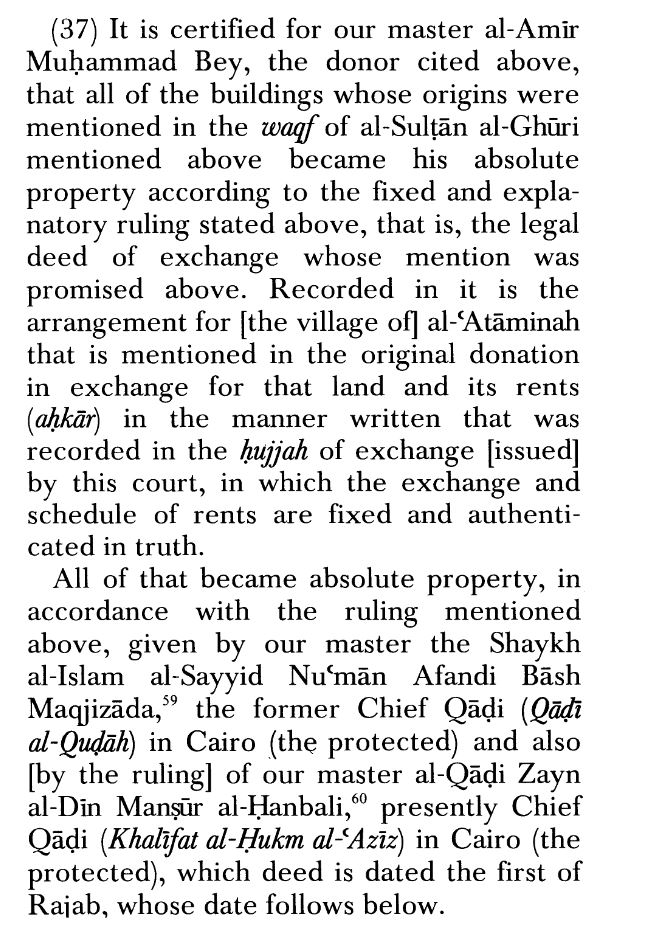
To fully grasp why the Mamluks cannot be prophetically identified as a sovereign “King of the South,” we must look at their own legal documents. Below is an excerpt from the waqf (charitable endowment deed) of Muhammad Bey Abu al-Dhahab. Established in 1774, this document was created by one of the most powerful and wealthy Mamluk warlords in Egypt just decades before Napoleon’s invasion.
Despite his immense military power, the legal language within his own property deed irrefutably proves his submission to the Ottoman Empire.
Here is the text of paragraph 37 from the deed:
(37) It is certified for our master al-Amir Muhammad Bey, the donor cited above… that all of that became absolute property, in accordance with the ruling mentioned above, given by our master the Shaykh al-Islam al-Sayyid Nu’man Afandi Bash Maqjizada, the former Chief Qadi (Qadi al-Qudah) in Cairo (the protected) and also [by the ruling] of our master al-Qadi Zayn al-Din Mansur al-Hanbali, presently Chief Qadi (Khalifat al-Hukm al-‘Aziz) in Cairo (the protected)…
When we break down the legal terminology in this single paragraph, the “King of the South” narrative entirely collapses:
-
Titles of Subordination, Not Sovereignty: The document legally identifies the donor as “our master al-Amir Muhammad Bey.” “Amir” is a military title meaning commander, and “Bey” is a Turkish provincial designation. He is never referred to as Sultan (Emperor) or Malik (King). Legally, he is classified as a high-ranking military officer within a larger empire, not an independent monarch.
-
Submission to a Higher Court: If Abu al-Dhahab were an independent, sovereign king, his decree alone would be the law of the land. Instead, the text shows he had to go to a separate legal body to have his property rights certified and authenticated. He is submitting his wealth to a legal system greater than himself.
-
The Supreme Authority of the Ottoman Qadi: The text explicitly states that Abu al-Dhahab’s property rights are entirely dependent on the rulings of the “Chief Qadi [Judge] in Cairo.” Historically, the Chief Qadi of Cairo was never an Egyptian or a Mamluk; he was a high-ranking Ottoman state official dispatched directly from Istanbul by the Ottoman Sultan. This powerful Mamluk warlord is literally bowing to the legal ruling of the Ottoman Sultan’s appointed representative in order to protect his own property.
-
Ottoman Cultural and Imperial Markers: The document utilizes titles such as “Afandi” (Effendi), a classic Ottoman Turkish title of respect for government officials and scholars. The presence of this title further cements that the legal apparatus ratifying this Mamluk’s wealth was culturally, legally, and officially Ottoman.
The Conclusion of the Evidence This primary source document provides hard, historical proof that the Mamluks did not have sovereign authority over the territory of Egypt. Even the wealthiest, most dominant Mamluk warlords had to go to the Ottoman courthouse, stand before an Ottoman-appointed judge, and receive an Ottoman legal ruling just to manage their own local affairs. Because Egypt was legally Ottoman territory, governed by Ottoman courts, the “King of the South” in 1798 could only have been the Ottoman Empire itself.