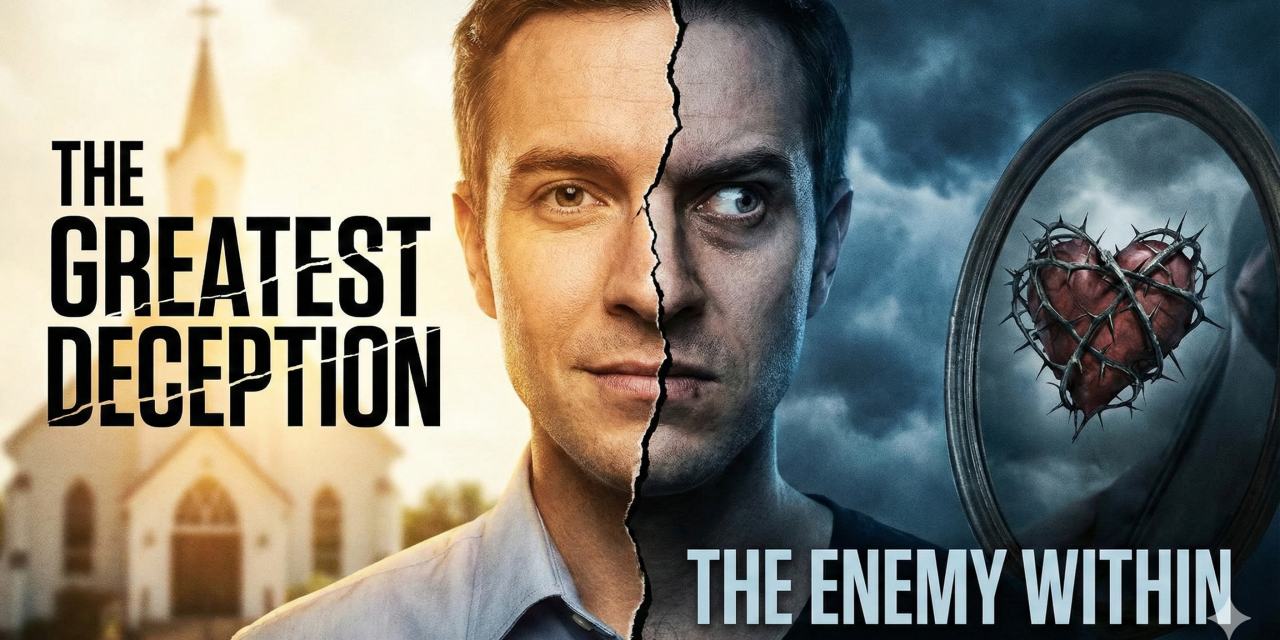
THE GREATEST DECEPTION: The Enemy Within
We live in an age of conspiracy theories. From secret societies and government cover-ups to debates about vaccines and the shape of the earth, people are obsessed with uncovering “the truth.” Many Christians spend hours researching the latest deceptions in the media, politics, and theology.
But what if the greatest deception isn’t out there—in the government, the Vatican, or the secret societies? What if the greatest deceiver you will ever face is looking back at you in the mirror?
In this study, we will unmask the most dangerous enemy of all: The Human Heart.
I. THE NATURE OF THE HEART
1. How does the Bible describe the natural human heart?
Jeremiah 17:9 — “The heart is deceitful above all things, and desperately wicked: who can know it?”
Answer: The Bible teaches that our heart is the most deceitful thing in existence. We often think we are good people, or that we are “right,” but our own hearts are constantly trying to trick us. The word “desperately wicked” also translates to “crooked.”
2. What does the Bible mean by “Heart”?
1 Chronicles 28:9 — “…serve him with a perfect heart and with a willing mind: for the Lord searcheth all hearts, and understandeth all the imaginations of the thoughts.”
Answer: In Scripture, the “heart” is synonymous with the mind, the intellect, and the emotions. It is the control center of our being.
3. What is the world’s most popular advice regarding the heart? Common Saying: “Follow your heart.”
Proverbs 28:26 — “He that trusteth in his own heart is a fool: but whoso walketh wisely, he shall be delivered.”
Answer: Disney movies, pop songs, and Hollywood all preach the same message: “Follow your heart, it knows the way.” The Bible says the exact opposite. Because the heart is deceitful, following your feelings is a recipe for disaster, broken homes, and sin.
4. What promise does God give regarding our hearts?
Ezekiel 36:26 — “A new heart also will I give you, and a new spirit will I put within you…”
Answer: God doesn’t want to fix your old heart; He wants to give you a brand new one. He wants to replace the “stony” (selfish) heart with a heart of flesh that is responsive to His Spirit.
II. THE TWO DITCHES: Emotion vs. Intellect
5. How do our emotions deceive us in relationships?
James 1:20 — “For the wrath of man worketh not the righteousness of God.”
Answer: Our feelings often lead us to make false assumptions about others. If we dislike someone, our “heart” will fill in the gaps with negative assumptions, convincing us they are evil based on zero evidence. We judge based on how we feel rather than what is true.
6. What is the biblical way to handle conflict?
Matthew 18:15 — “If thy brother shall trespass against thee, go and tell him his fault between thee and him alone…”
Answer: The deceitful heart wants to gossip, post on social media, or complain to friends. The converted heart goes directly to the person to resolve the issue.
7. In what spirit should we correct others?
Galatians 6:1 — “…restore such an one in the spirit of meekness; considering thyself, lest thou also be tempted.”
Answer: Even if we are right, we can be wrong in our attitude. A harsh, critical spirit is a sign of self-deception.
8. Can our “Intellect” be just as dangerous as our emotions?
Proverbs 3:7 — “Be not wise in thine own eyes: fear the Lord, and depart from evil.”
Answer: Yes. This is a specific trap for those who love Bible study. We can trust in our own logic, our ability to debate, and our “superior knowledge” of doctrine. We think we are safe because we know the truth, but we are trusting in our own brain power rather than God.
9. What is the true definition of “Fearing the Lord”?
Proverbs 3:5 — “Trust in the Lord with all thine heart; and lean not unto thine own understanding.”
Answer: To fear the Lord means to distrust your own wisdom. It means acknowledging that you are prone to error and need God to teach you.
III. THE RELIGIOUS PHARISEE
10. What parable warns against religious pride?
Luke 18:9 — “And he spake this parable unto certain which trusted in themselves that they were righteous, and despised others.”
Answer: The Parable of the Pharisee and the Publican. The Pharisee was “active in church,” paid tithe, and kept the rules, but he was deceived. He thought he was righteous because he compared himself to others.
11. What was the Pharisee’s fatal mistake?
Luke 18:11 — “God, I thank thee, that I am not as other men are…”
Answer: He focused on the sins of others to validate his own goodness. A self-deceived Christian is easy on themselves but hard on everyone else.
12. What is the condition of the Laodicean church?
Revelation 3:17 — “Because thou sayest, I am rich… and have need of nothing…”
Answer: Pride feels no need. The greatest danger of the last-day church is not that they are ignorant, but that they think they are “rich” in truth and do not realize they are spiritually bankrupt.
13. Can you have “Truth” and still be lost?
1 Corinthians 13:2 — “…though I have the gift of prophecy, and understand all mysteries… and have not charity, I am nothing.”
Answer: You can understand the prophecy of the King of the North, the 2520, the nature of Christ, and the Sabbath, yet still be nothing in God’s eyes if you lack His character of love.
14. What is the definition of a true Christian?
Spirit of Prophecy Quote (Desire of Ages, p. 504): “Unless there is practical self-sacrifice for the good of others… whatever our profession, we are not Christians.”
Answer: A Christian is one who represents Christ. Christ’s life was total self-sacrifice. If our religion is just debates and theory, but no sacrifice for others, we are not Christians.
IV. THE FINAL JUDGMENT
15. What terrifying words will Jesus speak to many active believers?
Matthew 7:22-23 — “Many will say to me in that day, Lord, Lord, have we not prophesied in thy name?… And then will I profess unto them, I never knew you.”
Answer: These people were not atheists; they were active ministry workers. They did “many wonderful works,” but they were self-deceived. They never had a relationship with Jesus that changed their hearts.
16. Why must we “Demolish” the house before rebuilding?
Jeremiah 1:10 — “See, I have this day set thee over the nations and over the kingdoms, to root out, and to pull down, and to destroy, and to throw down, to build, and to plant.”
Answer: When remodeling a broken-down house, you have to gut the rotten materials before you can build new. God has to break our pride and “demo” our self-confidence so He can build a character that will stand the storm.
17. How do we combat the enemy within?
Psalm 139:23-24 — “Search me, O God, and know my heart… and see if there be any wicked way in me.”
Answer: We must stop searching for the faults in others and ask God to search us. We must study the Bible not to fight enemies around us, but to conquer the enemy inside us.
18. Who is the only one who can save us from ourselves?
Jude 1:24 — “Now unto him that is able to keep you from falling, and to present you faultless…”
Answer: Only Jesus can save us from our own deceitful hearts. We must lean entirely on Him.
Your Decision
The world says “Trust yourself.” The Bible says “Trust in the Lord.” Are you willing to admit that your own heart has deceived you? Will you stop looking at the faults of others and ask God to give you a new heart of humility and self-sacrifice today?