Two Sabbath Controversies: Looking at Others Through Christ’s Eyes
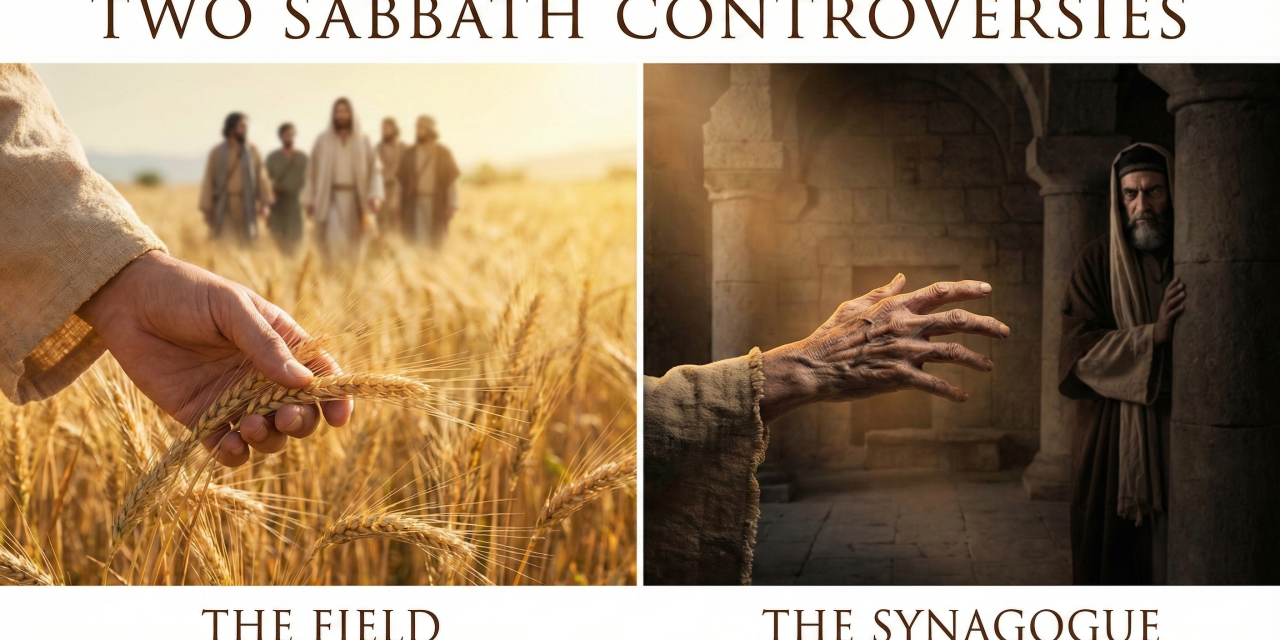
This sermon examines two controversies surrounding the Sabbath found in Mark chapters 2 and 3, where Jesus and His disciples were accused by the Pharisees of violating the Sabbath. The message reveals that Jesus did not break the Sabbath; rather, the Pharisees had substituted God’s commandments with man-made traditions and standards. The sermon emphasizes that the Sabbath was made for man as a memorial of both creation and redemption, representing rest in Christ’s finished work rather than our own labor. It challenges modern believers, particularly Adventists, to examine whether they are following God’s true commandments or have created their own creeds and standards. The core message contrasts two ways of looking at others: the Pharisees looked at others to accuse and condemn, while Christ looked at others to serve, comfort, and bring relief to their suffering. The sermon calls believers to adopt Christ’s perspective of compassion rather than the Pharisees’ spirit of judgment.
Key Points:
- Jesus Christ is Lord of the Sabbath and did not violate it; the controversy arose from the Pharisees’ man-made interpretations
- The Pharisees taught the commandments of men as doctrines, not the true commandments of God
- Modern believers can fall into the same trap of creating arbitrary standards and judging others by those standards rather than by God’s Word
- The Sabbath principle is about resting in Christ’s finished work, illustrated by Adam and Eve resting on the first Sabbath without having done any work themselves
- The Sabbath commemorates both creation and redemption, pointing to God’s work in bringing us out of slavery into freedom
- Jesus was grieved and angered by the hardness of the Pharisees’ hearts and their lack of compassion for suffering people
- There are two ways of looking at others: to accuse and condemn like the Pharisees, or to serve and comfort like Christ
- True righteousness is not about maintaining appearances through rigid adherence to man-made traditions, but about purity of heart and genuine obedience to God’s Word
- God will raise up true people at the end time whose work will put the professed Christian world to shame, similar to how Christ’s ministry exposed the Pharisees
Scripture References from the Sermon
Explicitly Mentioned Scripture References:
- 2 Timothy 3:12 – “All that will live godly in Christ Jesus shall suffer persecution”
- Luke 6:23 – “Rejoice ye in that day and leap for joy”
- 1 Peter 3:14 – “But if ye suffer for righteousness, happy are ye”
- Mark 2:23 – Jesus and disciples going through cornfields on the Sabbath
- Mark 2:24 – Pharisees questioning why disciples do what is unlawful on Sabbath
- Mark 3:1 – Jesus entering the synagogue where a man had a withered hand
- Mark 3:2 – Pharisees watching to see if Jesus would heal on the Sabbath
- Mark 2:27 – “The Sabbath was made for man and not man for the Sabbath”
- Mark 7:6-7 – “This people honoreth me with their lips, but their heart is far from me”
- Mark 2:24-26 – The story of David eating the showbread
- Exodus 20:11 – The Sabbath commandment referring to creation
- Deuteronomy 5:15 – The Sabbath as a memorial of deliverance from Egypt
- Mark 3:1-7 – The healing of the man with the withered hand
- Mark 3:5 – Jesus looking upon them with anger, being grieved by hardness of hearts
- Romans 7 (alluded to) – Paul being “alive without the law”
Scripture Allusions:
- Amos 3:3 – “Can two walk together unless they be agreed?” (mentioned as commonly misused)
- Genesis 2:1-3 – Creation and the institution of the Sabbath (implied in discussion)
- Revelation 12:17 / Revelation 14:12 – “Remnant people who keep the commandments of God and have the testimony of Jesus” (alluded to)
Relevant Verses Aligned with Main Themes:
- Matthew 12:1-8 – Parallel account of disciples plucking grain on Sabbath
- Matthew 12:9-14 – Parallel account of healing on the Sabbath
- Luke 6:1-11 – Another parallel account of both Sabbath controversies
- 1 Samuel 21:1-6 – The full story of David eating the showbread
- Matthew 15:8-9 – Parallel passage about teaching commandments of men as doctrines
- Isaiah 29:13 – The Isaiah prophecy Jesus quoted about honoring with lips
- Matthew 23:1-36 – Jesus’ condemnation of Pharisees’ hypocrisy
- John 3:17 – “God sent not his Son to condemn the world” (theme of not condemning)
- Luke 9:56 – Jesus came not to destroy men’s lives but to save them (mentioned at end)
- Hebrews 4:9-10 – Rest that remains for the people of God
Total: 28 scripture references (15 explicitly mentioned, 3 alluded to, 10 thematically relevant)