
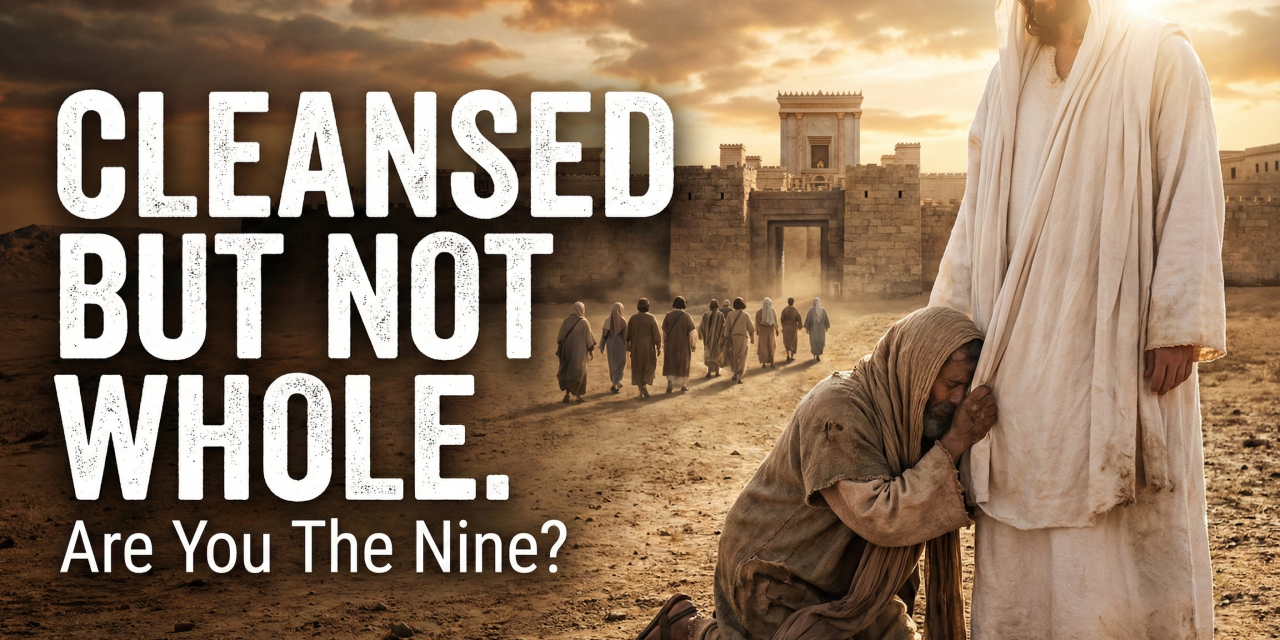
Cleansed, But Not Made Whole: The Forgotten Lesson of the Ten Lepers
The day after Thanksgiving has become synonymous with Black Friday—a peculiar tradition where people who just celebrated being thankful for everything they have rush out to acquire more things they don’t need. The irony is almost comical: a fire station burning down, a police station getting robbed, or a day of gratitude immediately followed by a frenzy of consumption.
This contradiction reveals something profound about human nature. We’re quick to forget. We’re rarely satisfied. Contentment eludes us. And thankfulness? That seems to have an expiration date of about 24 hours.
The Story That Mirrors Our Condition
In Luke 17, we encounter ten lepers who stood “afar off” when they met Jesus. This wasn’t merely a geographical description—it was a commentary on their entire existence. According to Levitical law, lepers had to tear their clothes, leave their heads uncovered, wear a covering over their mouths (essentially a mask), and cry out “Unclean! Unclean!” wherever they went.
Even more devastating, they had to dwell alone, quarantined outside the camp. Jewish tradition specified they must maintain a distance of four cubits—approximately six feet—from others. Sound familiar?
Leprosy wasn’t just a disease; it was a living death. Nerve damage meant lepers couldn’t feel pain, leading to unnoticed injuries that would become infected. Their flesh would literally rot while they were still alive. The smell was unbearable. They were cut off from society, considered cursed by God, experiencing perhaps the worst existence imaginable in biblical times.
When Desperation Breaks Down Walls
Here’s where the story gets interesting: among these ten lepers were both Jews and Samaritans—groups who normally despised each other. But leprosy changed everything. When you’re all doomed to die, when you’re all in the same miserable condition, social distinctions and racial prejudices suddenly don’t matter much.
Birds of a feather flock together, and their shared suffering created an unlikely unity.
They cried out together: “Jesus, Master, have mercy on us!”
Jesus responded with a simple instruction: “Go show yourselves to the priests.” And as they went, something miraculous happened—they were all cleansed.
The One Who Returned
Only one turned back. One out of ten. And significantly, he was a Samaritan—the outsider, the one considered less likely to do the right thing. He fell at Jesus’ feet, glorifying God with a loud voice, overwhelmed with gratitude.
The other nine? They went straight to the temple, back to their religious duties, back to their old lives—including, remarkably, their old prejudices.
Jesus asked the obvious question: “Were there not ten cleansed? Where are the nine?”
Then He spoke words to the Samaritan that He didn’t speak to the others: “Arise, go your way. Your faith has made you whole.”
All ten were cleansed. Only one was made whole.
The Difference Between Cleansed and Whole
This distinction is everything. Many people experience a form of cleansing—they change their behaviors, join a church, give up certain vices, adopt new practices. They’re cleansed from their worldly ways. But are they made whole?
Being made whole requires something deeper: a heart overflowing with gratitude, a faith that recognizes the source of all good gifts, a humility that never forgets what condition we were in and what mercy brought us out.
Revelation 3:17 speaks to those who say, “I am rich, increased with goods, and have need of nothing,” not knowing they are “wretched, miserable, poor, blind, and naked.” Perhaps we’ve been cleansed in our thinking, enriched with knowledge and truth, but not truly made whole in our hearts.
The Spiritual Leprosy We All Share
Sin is the leprosy that afflicts every human being. Romans tells us that all have sinned and fallen short. Our righteousness apart from Christ is like the filthy garments of a leper. We’re all outcasts from heaven in our natural condition, quarantined on this planet, separated from God.
This is the one thing we all have in common—Jew and Gentile, Catholic and Protestant, believer and unbeliever alike. We’re all spiritual lepers.
So why do we act like we’re better than others? Why do we focus so much energy on discerning the errors of others while remaining blind to our own condition?
True unity will never come from councils and conferences where people debate doctrinal differences. Unity comes when we all recognize we’re standing in the same desperate condition, crying out together for mercy.
The Gift of Everything
First Timothy 6:6-8 reminds us that “godliness with contentment is great gain. For we brought nothing into this world, and it is certain we can carry nothing out.”
James 1:17 adds: “Every good gift and every perfect gift is from above.”
We don’t actually own anything. Everything good in our lives is a gift—our health, our families, our homes, our abilities. We’re simply stewards, caretakers of what belongs to God.
When we truly grasp this, gratitude becomes natural. When we forget it, we become like the nine lepers who took their healing for granted and moved on without thanksgiving.
Living Thankfully in Every Circumstance
“In everything give thanks,” Paul wrote in 1 Thessalonians 5:18. In everything? Even in loss, suffering, exhaustion, and disappointment?
Yes—but only when we recognize what God has truly done for us. Only when we remember we were lepers and He made us clean. Only when our hearts overflow with the same gratitude that caused one man to turn back and fall at Jesus’ feet.
The challenge isn’t just to be thankful on Thanksgiving or joyful on Sabbath. It’s to cultivate a heart that remains grateful in every circumstance, recognizing that we’ve been given infinitely more than we deserve.
The Question That Remains
Were there not ten cleansed? Where are the nine?
It’s a question that echoes through time, landing squarely in our own hearts. Have we been cleansed but not made whole? Have we changed externally while remaining unchanged internally? Have we received mercy upon mercy yet forgotten to return with thanksgiving?
The one leper was made whole not because he was better than the others, but because his faith expressed itself in gratitude. His heart recognized the gift. His life became a testimony of thanksgiving.
May we be found among those who return, who fall at the feet of Jesus, who never forget what we’ve been saved from and what we’ve been saved for. May we be not just cleansed, but truly made whole.
Scriptures Used
Explicitly Mentioned and Read:
- Luke 17:11-19 – The account of the ten lepers (primary text)
- Leviticus 13:45-46 – Laws regarding lepers wearing torn clothes, covering their upper lip, crying “unclean,” and dwelling alone
- Revelation 3:17 – The Laodicean message about being “wretched, miserable, poor, blind, and naked”
- Psalm 100:4 – “Enter into his gates with thanksgiving and into his courts with praise”
- Psalm 107:1 – “Oh, give thanks unto the Lord, for he is good. His mercy endures forever”
- 1 Thessalonians 5:18 – “In everything give thanks”
- 1 Timothy 6:6-8 – “Godliness with contentment is great gain”
- James 1:17 – “Every good gift and every perfect gift is from above”
Alluded to or Quoted:
- Romans 3:10 – “There’s none righteous, no, not one”
- Romans 3:23 – “All have sinned and fallen short of the glory of God”
- Isaiah 64:6 – Reference to “our righteousness is as filthy rags” (described as “garments of a leper”)
- Matthew 9:12 / Mark 2:17 / Luke 5:31 – “They that are whole have no need of a physician, but those that are sick”
Relevant Verses for Themes Discussed:
- Ephesians 2:8-9 – Faith and salvation (related to “thy faith has made thee whole”)
- Colossians 3:15-17 – Thankfulness in all things
- Philippians 4:11-13 – Contentment in every circumstance
- 1 Corinthians 4:7 – Everything we have is a gift from God
- Psalm 24:1 – “The earth is the Lord’s and the fullness thereof” (stewardship theme)
- James 4:6 – “God resists the proud but gives grace to the humble”
Discussion Questions
How does the story of the ten lepers challenge us to examine whether we have been ‘cleansed’ in our Christian walk but not truly ‘made whole’ in our hearts?
In what ways do we, like the nine lepers who didn’t return, take God’s blessings for granted and fail to express genuine gratitude?
What does it reveal about human nature that the day after Thanksgiving, focused on gratitude, is followed by Black Friday, characterized by greed and discontent?
How does the requirement for lepers to wear masks, social distance, and quarantine parallel our spiritual separation from God due to sin?
Why do you think the only leper who returned to thank Jesus was a Samaritan, an outsider, rather than one of the nine Jews who knew the Scriptures?
What barriers of pride, prejudice, or self-righteousness prevent us from recognizing that we are all spiritual lepers in need of the same Savior?
How can understanding that ‘we own nothing’ and that every good gift comes from God transform our attitudes toward contentment and thankfulness?
In what ways might Seventh-day Adventists, despite having doctrinal truth, still be ‘rich and increased with goods’ yet spiritually ‘wretched, miserable, poor, blind, and naked’?
What is the difference between intellectual knowledge of truth and the faith that truly makes us whole, as Jesus said to the one leper?
How do our daily attitudes, complaints, and lack of joy reveal whether we truly grasp the magnitude of what Christ has done for us?