The Eagle is Landing: A Warning for Modern Christianity
In 66 AD, something remarkable happened that would serve as both a historical event and a prophetic warning for generations to come. The Roman General Cestius Gallus surrounded Jerusalem with the 12th Roman Legion, penetrated portions of the city, and then—inexplicably—withdrew. The Jewish historian Josephus noted that he “retired from the city without any reason in the world.” But there was a reason. He had a role to play in fulfilling the words of Jesus Christ.
What happened next reveals a pattern that echoes through history and speaks directly to our time.
The Abomination That Signals Desolation
In Matthew 24:15, Jesus warned: “When you therefore shall see the abomination of desolation, spoken of by Daniel the prophet, stand in the holy place, whoso readeth, let him understand.” He continued with urgent instruction: “Then let them which be in Judea flee into the mountains.”
But what was this abomination?
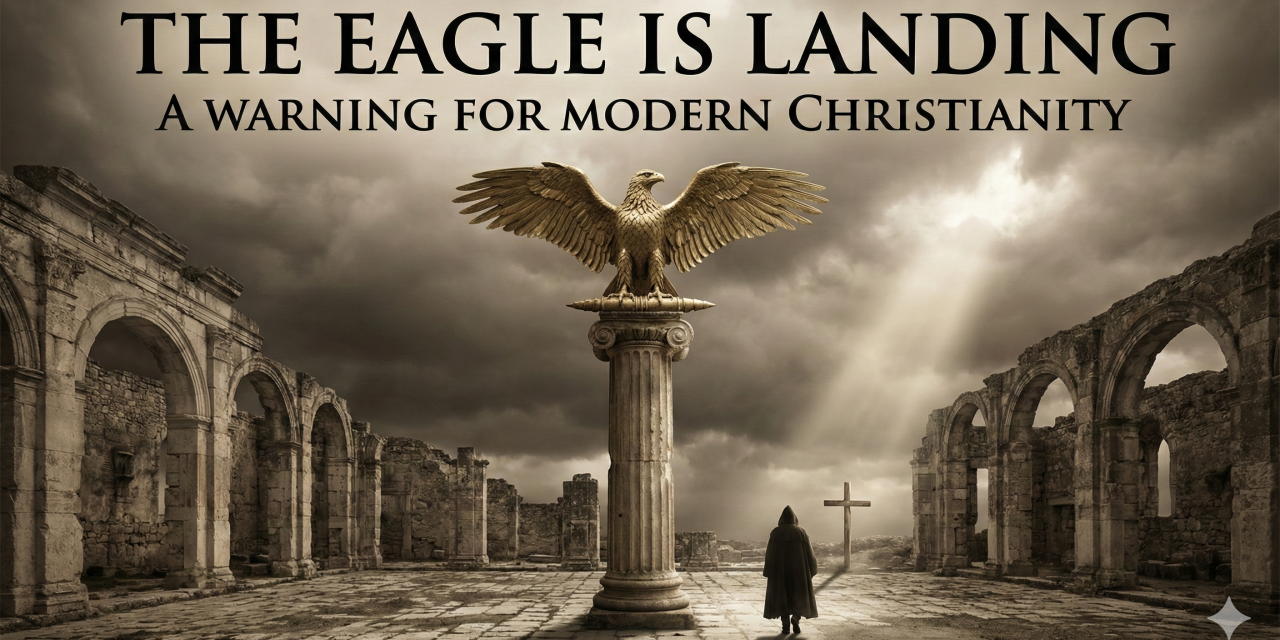
When Jewish zealots pursued the retreating Romans, they achieved a stunning victory at Beth Haran. Among their spoils was something the Romans considered sacred—the Aquila, the Golden Eagle. This eagle banner represented Jupiter, the Roman god, and was the very heart and soul of the Legion. Roman soldiers even made sacrifices to it.
These Jewish rebels brought this idolatrous emblem back to Jerusalem and paraded it through the streets as a symbol of their triumph. The abomination of desolation was standing where it ought not. For Christians who understood Jesus’s warning, this was the unmistakable signal: it was time to flee.
The destruction that followed was catastrophic. Between 66 and 70 AD, false Christs and false prophets arose, convincing thousands that God would deliver them from Roman oppression. One false prophet led 6,000 women and children to gather in the temple, only for them to perish when it was destroyed. Even as Roman armies breached the walls, these deceivers cried, “Hold your ground! God is going to save us!”
But God had already departed. The house was left desolate.
Two Kingdoms, Two Methods
At the heart of this historical account lies a fundamental spiritual principle that defines the great controversy between good and evil: the difference between drawing and forcing.
Jesus declared in John 12:32, “If I be lifted up from the earth, I will draw all men unto Me.” The power of the gospel is not in coercion, manipulation, or force—it’s in the self-sacrificing love of Christ that draws people to Him. No one is forced into the Kingdom of God. The cross has a magnetic power that attracts hearts when they see something they cannot find anywhere else in the world: love that gives everything, even in the face of hatred and death.
In stark contrast, Jesus explained to His disciples: “You know that the princes of the Gentiles exercise dominion over them, and they that are great exercise authority upon them. But it shall not be so among you” (Matthew 20:25-26). The world’s kingdom operates through power, control, and force. The devil himself is described in 1 Peter 5:8 as “a roaring lion, walketh about, seeking whom he may devour.”
This is the spirit of Babylon—the earthly manifestation of Satan’s spiritual kingdom. From ancient Babylon through Egypt, Medo-Persia, Greece, and Rome, the same principle has prevailed: survival of the most powerful, dominion through force.
When the Church Loses Its Power
History reveals a disturbing pattern: when the church departs from the simplicity of the gospel and loses the Spirit and power of God, it inevitably seeks alternative means to control consciences and attract adherents.
The early church, when it became corrupted and accepted heathen rites and customs, lost the Spirit and power of God. To control the consciences of people, it sought the support of secular power. The result was the papacy—a church that controlled the state and employed it to punish heresy.
The Jewish nation in Christ’s time provides another sobering example. When Jesus told them, “Behold, your house is left unto you desolate,” they were already devoid of God’s Spirit. The result? They wanted a political, conquering Messiah who would use force to establish God’s kingdom on earth. They didn’t realize they had adopted the very methods of their Roman oppressors—the methods of the devil himself.
The Modern Abomination
Fast forward to today. Has Protestant Christianity lost the power and simplicity of the gospel? The evidence suggests an alarming answer: yes.
In recent decades, we’ve witnessed the “seeker-sensitive” movement transform churches into entertainment venues. Contemporary worship bands that mimic concerts. Smooth-talking prosperity preachers. Coffee bars and merchandise stores in church lobbies. Pastors driving motorcycles and monster trucks into sanctuaries. Ministers berating congregants from the pulpit for not pledging enough money.
One megachurch stages an annual Christmas spectacular complete with flying Santas, dancing elves on trapezes, rapping penguins, and toy soldiers—all in the name of celebrating the humble birth of Christ. The irony is staggering: celebrating the Prince of Peace with the very opposite of how He actually came.
When worldly idols—the gods that the world worships—come into churches and are celebrated there, desolation is near. The number one idol in our world today is money, and many churches have become slaves to the almighty dollar. Printed on that currency? An eagle. And the words “In God We Trust.”
The eagle is landing in our churches.
The Coming Force
Without the power of the gospel to retain members and draw people through divine love, what comes next? History provides the answer: the church will seek the power of the state to enforce its version of religion.
Revelation 13:11 describes a beast with “two horns like a lamb” that “spake as a dragon.” This lamb-like beast—a nation with a Christian appearance—will ultimately speak with the voice of the dragon, using force, fear, and the threat of death to compel compliance.
We’re already seeing the groundwork laid. Christian nationalism, originally called “Dominionism” or “Seven Mountain Dominionism,” teaches that Christians must conquer and control seven key spheres of society: government, family, religion, education, media, entertainment, and business. The stated goal? To prepare the world for Christ’s millennial reign on earth.
But this is Babylon’s method, not Christ’s. It’s the dragon speaking, not the Lamb.
A Personal Examination
This isn’t just about denominations and world events. It’s deeply personal. Have we lost the power of the gospel in our own lives? Are people drawn to us because of self-sacrificing love? Do our characters reflect Christ in such a way that others are attracted without coercion or manipulation?
Or have we, too, resorted to other means? Do we rely on debate, clever arguments, and intellectual persuasion rather than the demonstration of Christ’s love? Do we depend on programs, entertainment, and polished presentations instead of genuine spiritual power?
When we’re devoid of God’s Spirit, we inevitably seek alternative methods to gain influence and control. We may not realize we’re using force—it comes disguised as manipulation, coercion, or aggressive argumentation. But it’s force nonetheless, and it reveals the absence of divine power.
The Gospel of the Kingdom
Yet there is hope. Jesus declared in Matthew 24:14, “This gospel of the kingdom shall be preached in all the world for a witness unto all nations; and then shall the end come.”
Notice the key word: witness. The gospel will go to all the world not merely through proclamation but through demonstration—through a living witness of God’s character displayed in His people.
Before the final judgment, there will be among God’s people a revival of primitive godliness such as has not been witnessed since apostolic times. The Spirit of God will be poured out in unprecedented measure because the tribulation will be unprecedented. In response to the greatest crisis, God will move with the greatest power.
This revival will be characterized by the simplicity of the gospel—self-sacrificing love demonstrated in daily life. It will be seen in people who have peace when there should be no peace, joy in circumstances that should produce despair, and forgiveness toward those who persecute them.
This demonstration will be a rebuke to worldly, compromised Christianity. Just as Christ’s life exposed the hypocrisy of the Pharisees and provoked their hatred, so the true people of God will reveal the emptiness of churches that have lost their spiritual power. And the reaction will be fierce.
The Time is Now
The pieces are coming together faster than ever before. The eagle is landing. Tribulation is on the horizon. We are woefully unprepared.
But God is not standing idly by. Even now, Christ is moving behind the scenes in every nation, kindred, tongue, and people. He is preparing a people who will demonstrate His character to a watching
Scripture References
- Matthew 24:15 – The abomination of desolation
- Matthew 24:16 – Flee to the mountains
- Luke 21:19-20 – Jerusalem compassed with armies
- Mark 13:14 – Abomination standing where it ought not
- Matthew 24:21 – Great tribulation
- Matthew 24:23 – False Christs and false prophets
- Matthew 24:27 – Coming of the Son of Man like lightning
- John 12:31-32 – Christ lifted up, drawing all men
- John 6:44 – No man can come except the Father draw him
- Matthew 20:25-28 – Gentiles exercise dominion; the Son of Man came to serve
- 1 Peter 5:8 – The devil as a roaring lion
- Revelation 13:11 – Beast with two horns like a lamb
- Revelation 17 – Woman sitting on seven mountains (referenced)
- Matthew 24:14 – Gospel preached in all the world as a witness
- Deuteronomy 6:6-9 – Law written on heart, hand, forehead
- Isaiah 14 – King of Babylon/Lucifer
- Matthew 23:38 – “Your house is left unto you desolate”
- Hebrews 2:14-15 – Fear of death
- Revelation 13:15-17 – Mark of the beast; those who don’t worship killed
- 1 Timothy 6:10 – Love of money is the root of all evil
Relevant Verses for Main Themes
On False Prophets and Deception:
- Matthew 7:15-20 – Beware of false prophets in sheep’s clothing
- 2 Thessalonians 2:3-12 – The man of lawlessness and strong delusion
- 2 Corinthians 11:13-15 – Satan masquerades as an angel of light
On Force vs. Drawing:
- John 3:16 – God so loved the world
- Romans 2:4 – God’s kindness leads to repentance
- Hosea 11:4 – I drew them with cords of love
On Revival and the Latter Rain:
- Joel 2:28-32 – Outpouring of the Spirit
- Acts 2:17-21 – Peter’s quotation of Joel
- Zechariah 10:1 – Ask for rain in the time of the latter rain
- James 5:7-8 – Be patient for the early and latter rain
On Babylon and Religious Apostasy:
- Revelation 14:8 – Babylon is fallen
- Revelation 18:1-5 – Come out of her, my people
- 2 Timothy 3:1-5 – Form of godliness but denying its power
On Sacrifice and Service:
- Philippians 2:5-8 – Christ’s humility and service
- Mark 10:42-45 – Parallel passage to Matthew 20
- Galatians 5:13 – Serve one another in love
On the Character of God’s End-Time People:
- Revelation 14:12 – Patience of the saints; keep commandments and faith of Jesus
- Revelation 12:17 – Remnant who keep commandments and have testimony of Jesus