The Crusader or the Christ: Which Cross Are You Carrying?
Take a look around, and you will see it everywhere. It hangs from necklaces and dangles from earrings. It’s etched into gravestones, printed on books, and stamped onto the flags of entire nations. People ink it onto their skin and mount it on the walls of their homes.
The cross is one of the most universally recognized symbols in the world. And honestly, most of us really like the idea of the cross—as long as someone else is on it.
To the ancient Romans, the cross was not a piece of jewelry. It was an implement of torture, a symbol of supreme humiliation, and a curse. To put it in perspective, wearing a cross in the first century would be like wearing a silver guillotine or a gold-plated electric chair around your neck today. The person who went to the cross was a guilty, condemned criminal.
Yet, Jesus Christ—innocent, flawless, and perfect—embraced it. He took the guilt of the world upon Himself, suffered, and died for one solitary purpose: reconciliation.
Through the cross, He made peace between the Creator and the creation. He took the world’s greatest symbol of shame and transformed it into the world’s greatest symbol of love.
The Call to Self-Denial
Because we like the idea of someone else dying in our place—we often shrink from fully embracing what it actually means for us.
Before the cross, there was the incarnation. Jesus, the Son of God, humbled Himself, took on the form of a servant, and was obedient even to the point of death (Philippians 2:6-8). His death was simply the culmination of how He lived. But while we gladly celebrate His life and His death, we often gloss over the humility and the obedience.
Jesus didn’t tell His followers to just admire, venerate, or appreciate His cross. He said:
“If any man will come after me, let him deny himself, and take up his cross, and follow me.” (Matthew 16:24)
The world wants the cross of Christ, but we desperately want to skip the self-denial. We want to take up the cross while still living for ourselves. But the Apostle Paul understood the true weight of it. In Galatians 2:20, he wrote, “I am crucified with Christ: nevertheless I live; yet not I.”
Taking up the cross means the “old man” is dead. The old version of you that is selfish, greedy, proud, quick to anger, and eager to judge, criticize, or manipulate others—that version has to die on the wood.
The Shift: From Sacrifice to Conquest
Historically, the early Christians understood this. For them, taking up the cross often meant literal life and death. They were mocked, outcast, and persecuted.
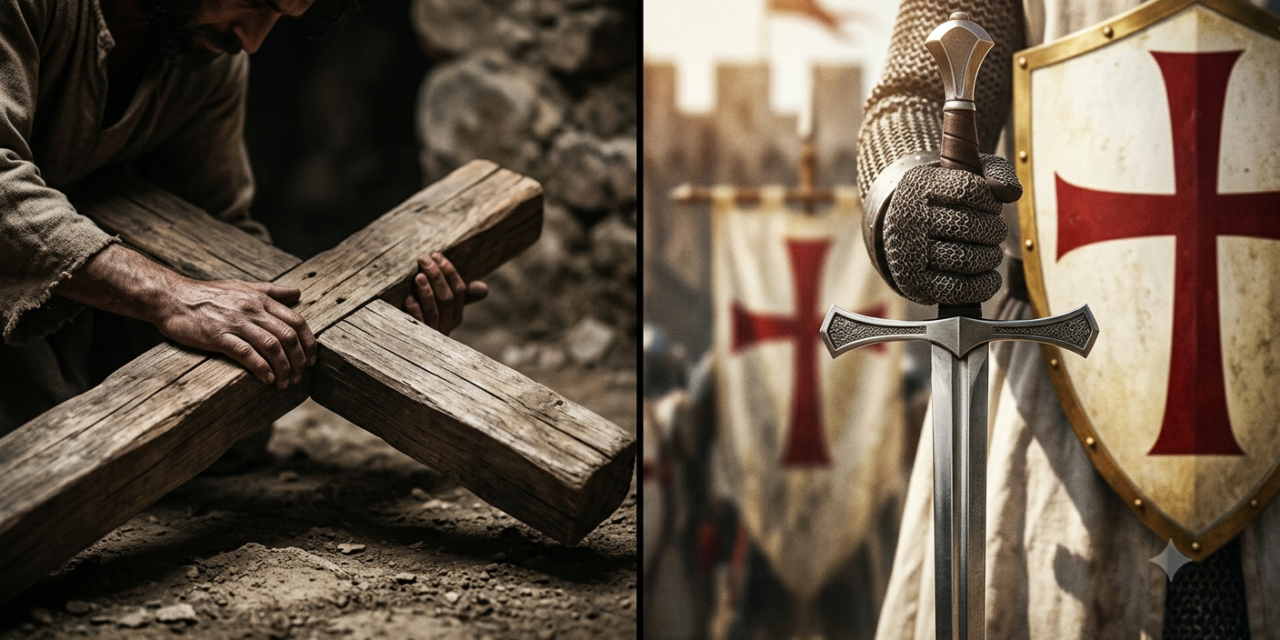
But by the fourth century AD, the meaning of the cross began to mutate. The Roman Emperor Constantine, preparing for the Battle of the Milvian Bridge, supposedly saw a vision of a cross in the sky with the words: “In this sign… conquer.” He instructed his soldiers to paint the symbol on their shields. He won a decisive military victory, and in doing so, fundamentally changed the course of the church.
The symbol of self-sacrifice and suffering became a symbol of imperial might. Instead of dying for one’s enemies, the cross became a banner for crushing them.
Centuries later, in 1095, Pope Urban II appealed to nobles, knights, and peasants to take up a “holy pilgrimage.” If they took up the cross and went to war to reconquer the Holy Land, they were guaranteed the remission of their sins. A soldier who had committed countless atrocities suddenly believed he could attain salvation simply by doing what he had always done: killing the enemy.
The crowd wept with joy and shouted, “Deus vult!” (God wills it!). Thus, the Crusader was born. Armed with relics like the “True Cross,” they believed they were conquering in the name of Christ, entirely missing the words Jesus spoke to Pilate: “My kingdom is not of this world: if my kingdom were of this world, then would my servants fight” (John 18:36).
The Modern-Day Crusader
We look back at the Crusaders and shake our heads, but that same spirit is alive and well today.
Today’s battlefield isn’t Jerusalem. It’s Facebook. It’s YouTube comment sections. It’s church business meetings. It’s our own living rooms.
People genuinely believe they are defending Jesus by taking up the cross and the sword to defeat His enemies. We don’t wield swords of steel; we wield words. We use the very words of God to destroy reputations, humiliate opponents, and put people to shame just to win an argument or settle a controversy.
We may win the argument, but we lose the Spirit of Christ.
We want a cross that crucifies others for our benefit. But is that the cross of Christ?
Which Cross Will You Carry?
When Jesus hung on the cross, four different groups of people—passersby, priests, soldiers, and even the unrepentant thief—all hurled the same taunt at Him: “Save yourself!”
Four times. Save yourself.
But Jesus wasn’t concerned with saving Himself. Looking down, He made sure His mother would be cared for. Looking at His executioners, who were in the very act of killing Him, He prayed, “Father, forgive them.”
Jesus laid down His life. He showed us that it is infinitely better to lay down your life for your friends (and your enemies) than to cut down the lives of your opponents.
So, which cross will you take up today?
- The Roman cross that sacrifices others, or the cross of Christ that sacrifices yourself?
- The cross that wins arguments, or the cross that wins hearts?
- The cross that condemns sinners, or the cross that dies for them?
- The cross of the Crusader, or the cross of the Christ?